About this product
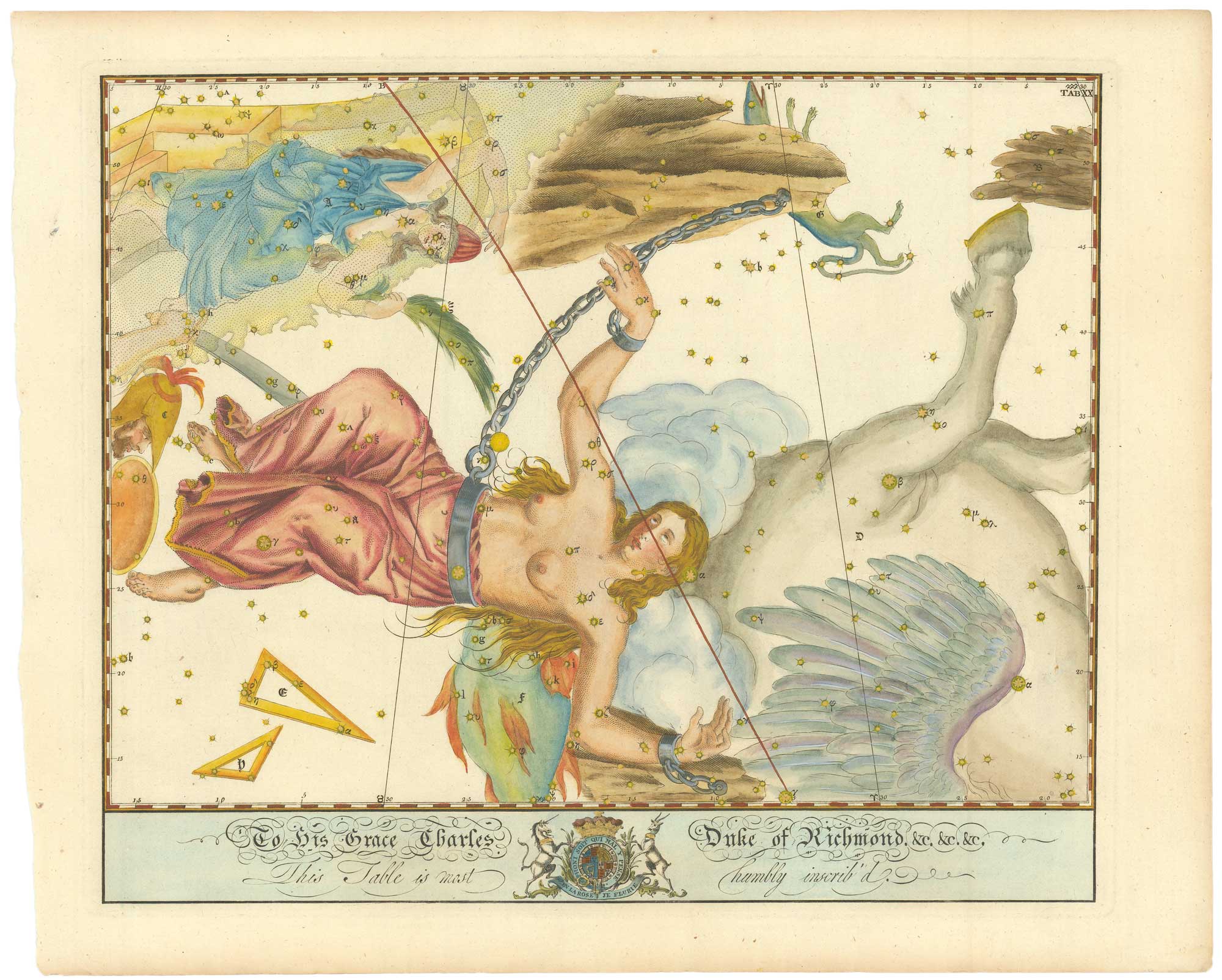
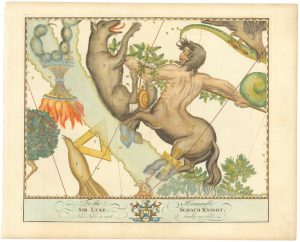
Tab. XX. [Andromeda]
Plate 20 of John Bevis’s Uranographia Britannica, the great British star atlas that was engraved but never published. Andromeda lies chained between two rocks, with the wing and forequarters of Pegasus above her. Two of Hevelius’s additions share the sheet, Lacerta the Lizard above and Triangulum Minus beside the old Triangulum at the bottom left.
The layout follows Bayer’s Uranometria of 1603 plate for plate, with more stars, corrected positions and the neighbouring constellations added. Each plate is dedicated to a subscriber; here to the 2nd Duke of Richmond.
Dr John Bevis (1695-1771), an Oxford-trained physician practising in London, discovered the Crab Nebula in 1731 and made the only recorded observation of one planet occulting another, Venus passing over Mercury on 28 May 1737. From his observatory at Stoke Newington he timed the transits of up to 160 stars a night for a year, adding his results to Flamsteed’s catalogue and Halley’s southern observations to build an atlas intended to surpass both Flamsteed and Bayer. The work was a collaboration with the instrument maker John Neale, who financed it by subscription and advertised it in 1748 as ‘an exact Survey of the Heavens, on fifty large Copper-Plates’. The finished atlas ran to fifty-one plates showing seventy-nine constellations and over 3,550 stars.
Show allShow less
In 1750, with the plates engraved and printing under way, Neale went bankrupt and the plates were seized by the Court of Chancery. The atlas was never issued. The surviving impressions were sold at auction in 1785 and bound up anonymously the following year as the Atlas Celeste. Around thirty sets are known, almost all in institutional collections; individual plates are rare on the market.
Add to Wishlist
In Alteagallery's own words. See it at Alteagallery