What actually changed in the Ode Brew Grinder Gen 2
Four things, based on what the specifications tell us.
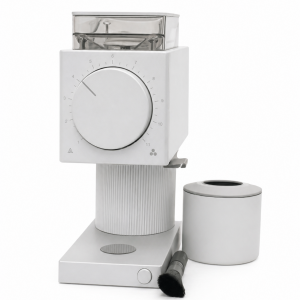
- Gen 2 Brew Burrs. They grind finer and with more precision, which widens the usable range at the tight end without crossing into espresso territory.
- New anti static technology. Less clinging, less mess on the counter, and fewer grounds stranded on the way to your brewer.
- A 100 gram capacity. Enough for a full batch brew in one go rather than two passes.
- A redesigned load bin. Beans feed more smoothly, which helps consistency across a dose.
Both generations are flat burr brew grinders with 31 settings and single dose loading, so if you already own the Gen 1 Ode and it is working for you, nothing here forces an upgrade. The honest summary is that the Gen 2 grinds finer, catches more, and throws less static.
Grind settings on the Ode Brew Grinder Gen 2 and which brewers they serve
Thirty one settings across a brew only range is more resolution than it sounds, because none of it is spent on espresso. Every click is doing useful work in the part of the range you actually brew in.
- The fine end. AeroPress with a short steep, and fast single cup pour overs. This is where the Gen 2 burrs bought you room the first generation did not have.
- Medium fine to medium. V60, Kalita, Chemex, and most electric drip machines. Roughly the texture of table salt. If your pour over finishes too fast and tastes thin, come finer here.
- Medium coarse. Larger batch drip and long contact pour overs, where you want the bed to drain steadily rather than stall.
- Coarse. French press and cold brew. Closer to raw sugar. Coarse keeps the press cup clean and stops a twelve hour cold brew steep from going muddy and bitter.
Our grind size guide gives you the visual reference points, and the perfect brew guide has the ratios and times we use on our own bar.
Specifications
- Gen 2 Brew Burrs, flat, stainless steel
- 31 grind settings with a grind guide
- New anti static technology
- 100 gram grinds capacity
- Redesigned load bin for smoother bean feeding
- Quiet grinding with automatic stop
- Single dose loading
- Low grind retention
- Magnetically aligned catch with pour fins, plus a grinds knocker
- Compact footprint
- Dimensions, 239 mm by 105 mm by 248.3 mm
- Weight, 4.6 kg or 10.14 lbs
- Cord length, 1 m
- Power, 120V, 140W, 1.3 A, 50 to 60 Hz
- Materials, aluminum body, plastic load bin and base, stainless steel burrs
- Intended for brewed coffee methods only. It does not grind for espresso
- Warning, CA Prop 65
Why a dedicated brew grinder changes the cup, from a roaster
Grinders that try to cover espresso and filter in one body have to compromise somewhere, usually in adjustment resolution. Espresso needs microscopic steps at the fine end, so a do everything grinder spends a large share of its range down there. Skip espresso and every one of those 31 settings lands in the zone where filter coffee lives. That is the practical argument for a brew only machine.
Flat burrs are the other half of it. Two facing rings cut the bean until the particles are small enough to exit the gap, which tends to produce a tight cluster of particle sizes. Uniform particles extract at similar rates. Mixed particle sizes give you dust that over extracts into bitterness sitting next to boulders that never give up their sweetness, in the same cup, at the same time. That muddled flavor is what most people are tasting when they blame the beans.
Then there is static and retention, which sound like housekeeping details and are not. Coffee picks up a charge as it is ground. Charged grounds stick to the chute and the catch, and grounds that stick are grounds that did not make it into your brewer, so your carefully weighed ratio quietly drifts. Worse, the ones left behind come out tomorrow, stale. The anti static work and low retention design on the Ode Brew Grinder Gen 2 are aimed squarely at both problems.
From where we sit, roasting in Concord, the grinder is the highest leverage piece of gear in a home setup. We can roast a lovely coffee, ship it fresh, and a blade chopper will flatten it in fifteen seconds. Grind right before you brew, because ground coffee has an enormous amount of surface area and it stales in minutes. Whole bean is the only honest way to buy it, which is how we sell our roasted coffee. For more on how roast level and grind interact, see choosing the perfect roast.
Frequently Asked Questions
Can the Ode Brew Grinder Gen 2 grind for espresso?
No. It is built for brewed coffee methods only, and the specifications are explicit about it. If you need espresso and filter from one grinder, the Opus is the machine to look at.
Is the Gen 2 worth it over the Gen 1?
If you are buying your first Ode, the Gen 2 is the current one and grinds finer with more precision, holds 100 grams, and has newer anti static technology. If you already run a Gen 1 happily, there is no urgent reason to replace it. Both are flat burr brew grinders with 31 settings.
How much coffee does the Ode Brew Grinder Gen 2 hold?
The catch cup capacity is 100 grams, which covers a full batch brew in a single pass. It loads one dose at a time rather than storing beans in a hopper, so the coffee sitting in the machine is only ever the coffee you are about to brew.
Is it loud?
The Ode Brew Grinder Gen 2 is specified as quiet grinding with an automatic stop, so it runs until the dose is through and then shuts itself off. It is noticeably more civil than a blade grinder in an early morning kitchen, and the automatic stop means you are not standing over it guessing.
How do I choose between this and a hand grinder?
An electric machine wins on speed and on batch size, and the Ode Brew Grinder Gen 2 will grind a full press dose while you are still filling the kettle. A hand grinder wins on portability and on price. Plenty of people own both, one on the counter and one in the travel bag. We are a working roastery in Concord, CA, so ask us and we will tell you honestly which one fits how you actually brew. For general background, coffee preparation is a reasonable overview.