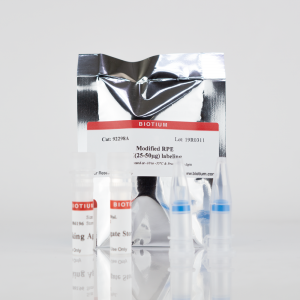
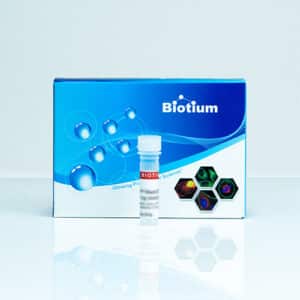
- Suitable for wide pH range, low reaction volumes, or low protein concentrations
- Highly soluble and stable in aqueous buffers
- Includes recombinant mouse IgG1 control protein — ideal for therapeutic antibody research.
- Perfect for high-throughput assays with low volumes and protein concentrations.
Kit Components
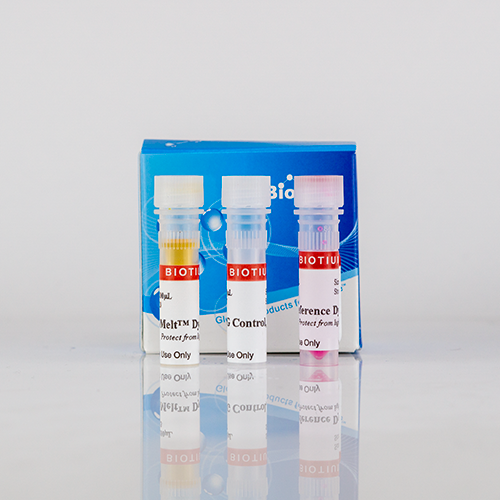
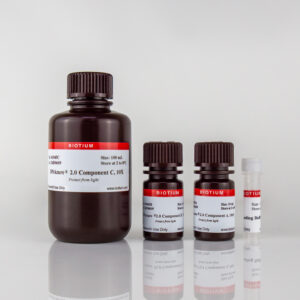
- GloMelt™ Dye, 200X
- Recombinant Mouse IgG1 Control, 5 mg/mL
- ROX Reference Dye, 40 uM
- (33028-T/33028-1 only)
Spectral Properties
- GloMelt™ Dye Ex/Em 468/507 nm
- ROX Reference Dye Ex/Em 575/600 nm
The GloMelt™ 2.0 Thermal Shift Protein Stability Kit features Recombinant Monoclonal Mouse IgG1 for performing control reactions. Compared to the polyclonal goat IgG control provided in our original GloMelt™ kit, this recombinant mouse antibody is more relevant for therapeutic antibody research and generates higher signal and a sharper melt peak between for robust assay validation.
A Simple and Rapid Method for Sample Screening
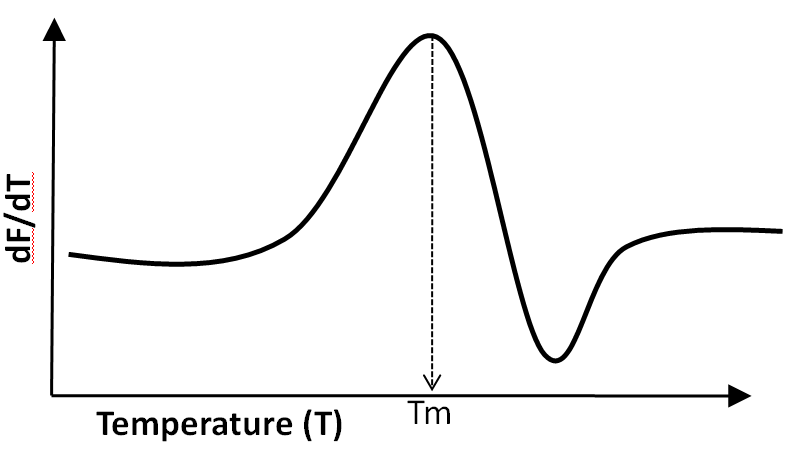
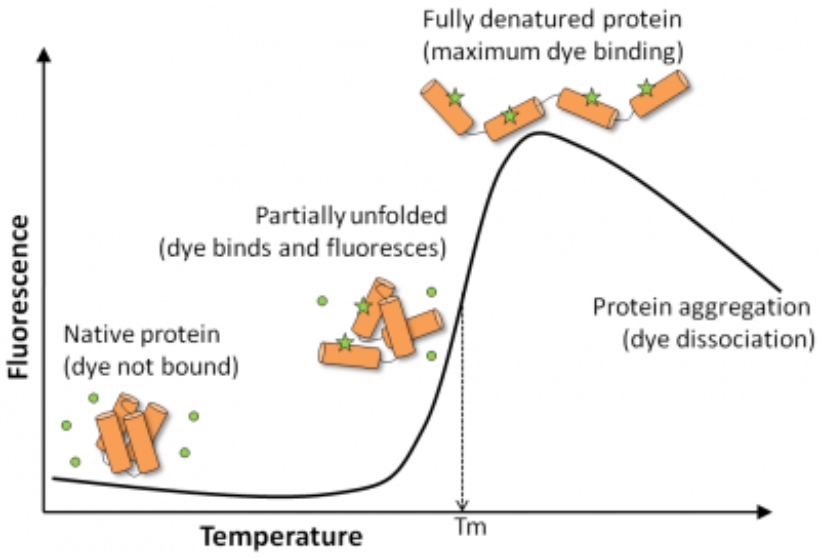
Figure 1. Environmentally sensitive fluorescent dyes can be used to monitor the temperature dependent unfolding of a protein. The protein’s melting temperature (Tm) is a reporter of the protein’s thermal stability.
GloMelt™ dye undergoes fluorescence enhancement upon binding to hydrophobic regions of denatured proteins, and therefore can be used to detect protein unfolding or measure thermal stability by performing a thermal shift assay, also called Protein Thermal Shift™, differential scanning fluorimetry, or Thermofluor assay.
The thermal shift assay is a rapid and inexpensive technique that quantifies change in protein denaturation temperature, and thus can be used to screen conditions that affect protein thermal stability, such as protein mutations, ligand binding, and buffer formulations (like pH, salts, detergents, and other additives). These assays are rapid (typically about 30 minutes) and are performed on a quantitative PCR system. The thermal shift method is compatible with high-throughput screening and requires much less protein than methods such as circular dichroism and differential scanning calorimetry.
Small molecule inhibitors of bromodomain proteins have shown therapeutic effects in cancer models. Here, a GloMelt™ thermal shift assay was performed on 10 ug bromodomain BRD2 in the presence of bromodomain inhibitors JQ1 or RVX-208. Inhibitor binding stabilized the protein as indicated by the shift of the melting curves.
GloMelt™ Dye vs. Competitors
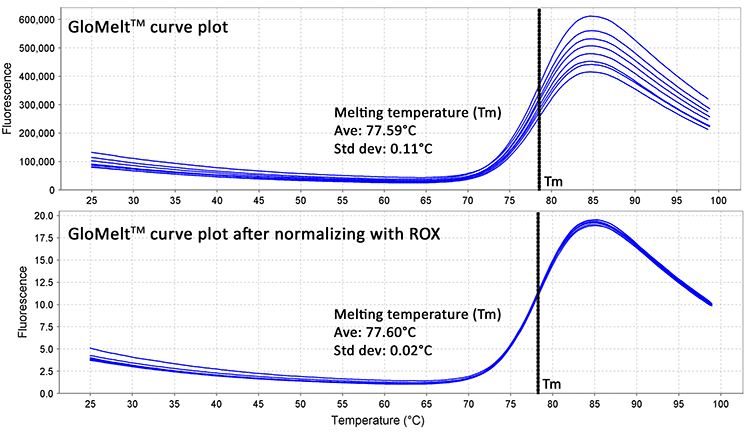
GloMelt™ Dye has significant advantages over other environmentally sensitive dyes, such as SYPRO® Orange and PROTEOSTAT® TS dye. GloMelt™ Dye generates a strong signal because it is optimized for detection in the SYBR® Green channel of qPCR instruments, and therefore low reaction volumes and low protein concentrations can be used. GloMelt™ Dye is compatible with high concentrations of protein stabilizers (such as glycerol and sorbitol), and also protein destabilizers (such as DTT and imidazole). GloMelt™ Dye performs very well in high detergent concentrations, unlike SYPRO® Orange. Another advantage is that ROX dye can be included with GloMelt™ Dye during thermal shift assays, which improves results by increasing replicate consistency in PCR instruments that require ROX passive reference dye.
Higher Tolerance for Detergents
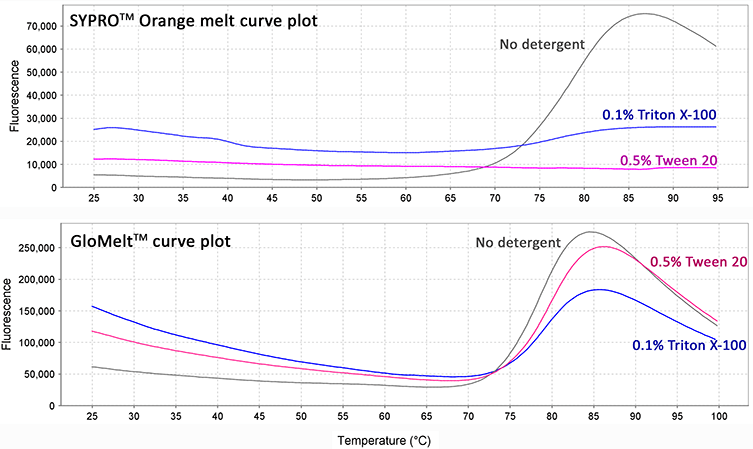
IgG melt curve plots in the presence of detergent. A thermal shift assay was performed on 20 ug IgG in the presence of 5X SYPRO® Orange or 1X GloMelt™ Dye, using a QuantStudio™ 5 qPCR system. The presence of detergent inhibited the SYPRO® Orange assay, but had little affect on the GloMelt™ curve.
Higher Tolerance for Reducing Agents
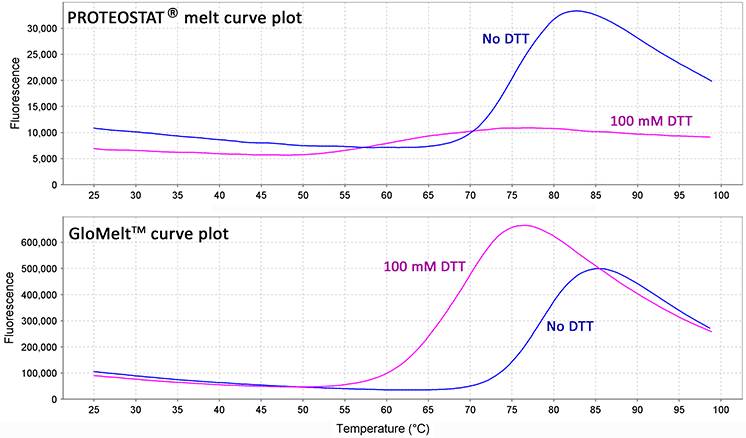
IgG melt curve plots in the presence of DTT. A thermal shift assay was performed on 25 ug IgG in the presence of 1X PROTEOSTAT® TS dye or 1X GloMelt™ Dye, using a QuantStudio™ 5 qPCR system. The presence of DTT drastically reduced the sensitivity of the PROTEOSTAT® assay, but had little affect on the GloMelt™ Dye. As expected, DTT reduced IgG thermal stability.
To learn more about GloMelt™ and see how it compares to competitor products, visit our GloMelt™ Technology Page.
SYBR is a registered trademark of Thermo Fisher Scientific. Proteostat is a registered trademark of Enzo Life Sciences.