- Determine the interrelationship of depression and anxiety and communicate how this information can be used in relation to treatment planning.
- Employ psychoeducation techniques that improve engagement in therapy by making neuroscience and neurobiology understandable for clients.
- Analyze how neural pathways regulating stress and reward are related to mental health disorders, and connect this information to your utilization of therapeutic interventions to reduce stress and manage addiction.
- Evaluate the relationship between memory malleability and trauma and communicate how this information can be utilized therapeutically to help clients cope with traumatic memories.
- Investigate how mindfulness and meditation impact the nervous system and articulate how mindfulness interventions can be used in your treatment plans for depression.
DOWNLOAD COURSE
Course Modules / Outline
Tour through the Brain: Understand Neuro-Physiology to Help Your Clients
- See and understand key brain structures and their function
- Work top down/ bottom up/ horizontally to help target interventions to clients’ specific needs
- Work with implicit and explicit memories to rewrite internal narratives and treat trauma
- Learn how to rebalance key pathways with your interventions:
- Pain Pathway
- Reward Pathway
- Fear-Stress Pathway including Polyvagal Theory
- Understand the physiological components of “Neuroception”
- Turning on the social engagement system for co-regulation
The Social Brain – How Therapy and Relationships Regulate Stress
- Understand elements of the social engagement system & use it to build rapport and heal attachment
- Help clients understand how emotions are contagious
- Activate mirror neuron systems for connection
- Help clients build stronger self-regulation
Neuroplasticity and Neurogenesis
- Neuroplasticity in all its forms – beyond neurogenesis
- How to foster neuroplasticity in clients
- Discover the conditions for ideal neuroplasticity
- Neuroplasticity in action: Exercise your brain!
- Actively engage brain structures for lasting change
- Default Mode (DMN) and Task Mode Networks (TMN)
- Long term potentiation (aka neuroplasticity at the synapse)
Practice the Interventions for Healing: Bottom-up, Top-down, and Horizontal
- Increase comfort and experience in integrating these interventions into your clinical practice:
- Sensory awareness
- Meditation and mindfulness
- Body work
- Unconscious and the DMN
- Experience and activate the direct mind-body link
Integrate the Brain into Treatments Trauma
- How stress alters the nervous system
- Explore techniques to calm the stress/fear pathway
- Develop security through self-soothing methods
- Foster confidence with yoga body positioning
- Reconsolidate implicit and explicit memories
Anxiety
- Distinguish top-down anxiety from bottom-up anxiety
- Implement treatments to effectively match the source of a client’s anxiety
- Treat worry and GAD effectively through worry exposure and planning
- Calm the limbic system bottom up with movement
- Develop alert/relaxed attention for better coping
- Soothe the insula through meditative sensory awareness
- Deconstruct sensations mindfully
- Balance the nervous system
Substance Abuse
- Brain areas involved in addictions
- Rewire the reward pathway
- Address habits that maintain addictions and lead to relapse
- Detach from pleasure and pain
- Develop prefrontal connections for better judgment
Depression
- Depressed brain patterns
- Practice the 4-step method to overcome negative self-suggestions
- Foster joyful relationship through mirror neurons
- Develop compassion and gratitude
- Activate an under-activated nervous system with yoga postures and energy meditations
Why Take This Course?
Because you want to go beyond theory and give your clients the hope — and real brain-based change — they deserve.
Talking about the brain with clients can feel overwhelming, but neuroscience doesn’t have to stay abstract. This training breaks down complex concepts into clear, practical tools you can start using immediately in your sessions.
If your clients are stuck in trauma loops, you’ll learn how to use neuroplasticity and memory reconsolidation to help them rewrite their inner narratives.
If you work with depression or anxiety, you’ll discover brain-informed methods to calm the limbic system, balance the nervous system, and shift negative patterns into healthier pathways.
If you treat substance abuse, you’ll get strategies to rewire the reward system and strengthen prefrontal control for long-term recovery.
And if you’ve ever struggled to keep clients engaged, this course will give you the language and psychoeducation skills to explain what’s happening inside their brain in a way that inspires trust and motivates change.
You’ll walk away with:
- A stronger ability to integrate neuroscience into everyday therapy
- Evidence-based interventions that work top-down, bottom-up, and relationally
- Tools to increase compliance, deepen client understanding, and accelerate healing
This course isn’t just about learning — it’s about transforming your clinical practice so you can help clients find lasting relief from trauma, anxiety, depression, and addiction.
Meet the Course Expert:
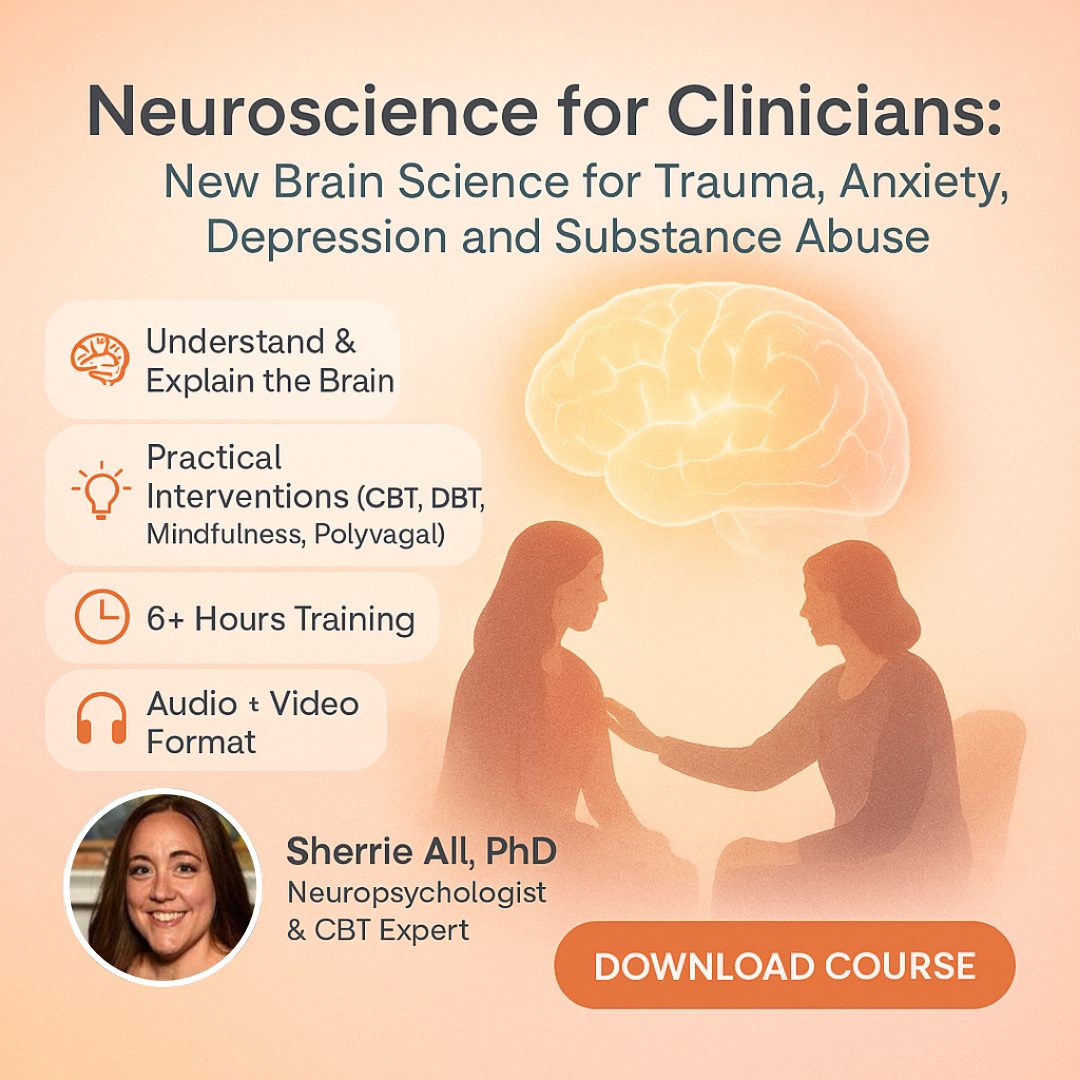
Sherrie All, PhD, is a neuropsychologist and an engaging speaker and writer whose expertise in the principles of neuroscience, functional neuroanatomy, and diagnostics give her a unique insight into the correlation between mental health disorders, therapeutic approaches, and what happens in the brain itself.
Dr. All is the owner of the Chicago Center for Cognitive Wellness where she combines her strong background in CBT with mindfulness techniques, motivational interviewing and dynamic interpretations to help her clients manage depression, stress, anxiety, mental illness and cognitive challenges. A trained neuropsychologist who received her Ph.D. from Rosalind Franklin University, she also brings her detailed understanding of the brain to uniquely address the needs of people with traumatic brain injuries, dementia, and other conditions.