Who needs it most
B12 occurs almost only in animal foods, so vegans and vegetarians are the clearest case — supplementation is not optional on a plant-based diet. Beyond that: adults over 50, whose stomach acid and intrinsic factor decline; anyone on long-term metformin or proton-pump inhibitors; and people after stomach or bowel surgery. If you want the whole B group instead of B12 alone, see Vitamin B Complex; folic acid works in the same homocysteine pathway and comes with the iron bisglycinate tablets.
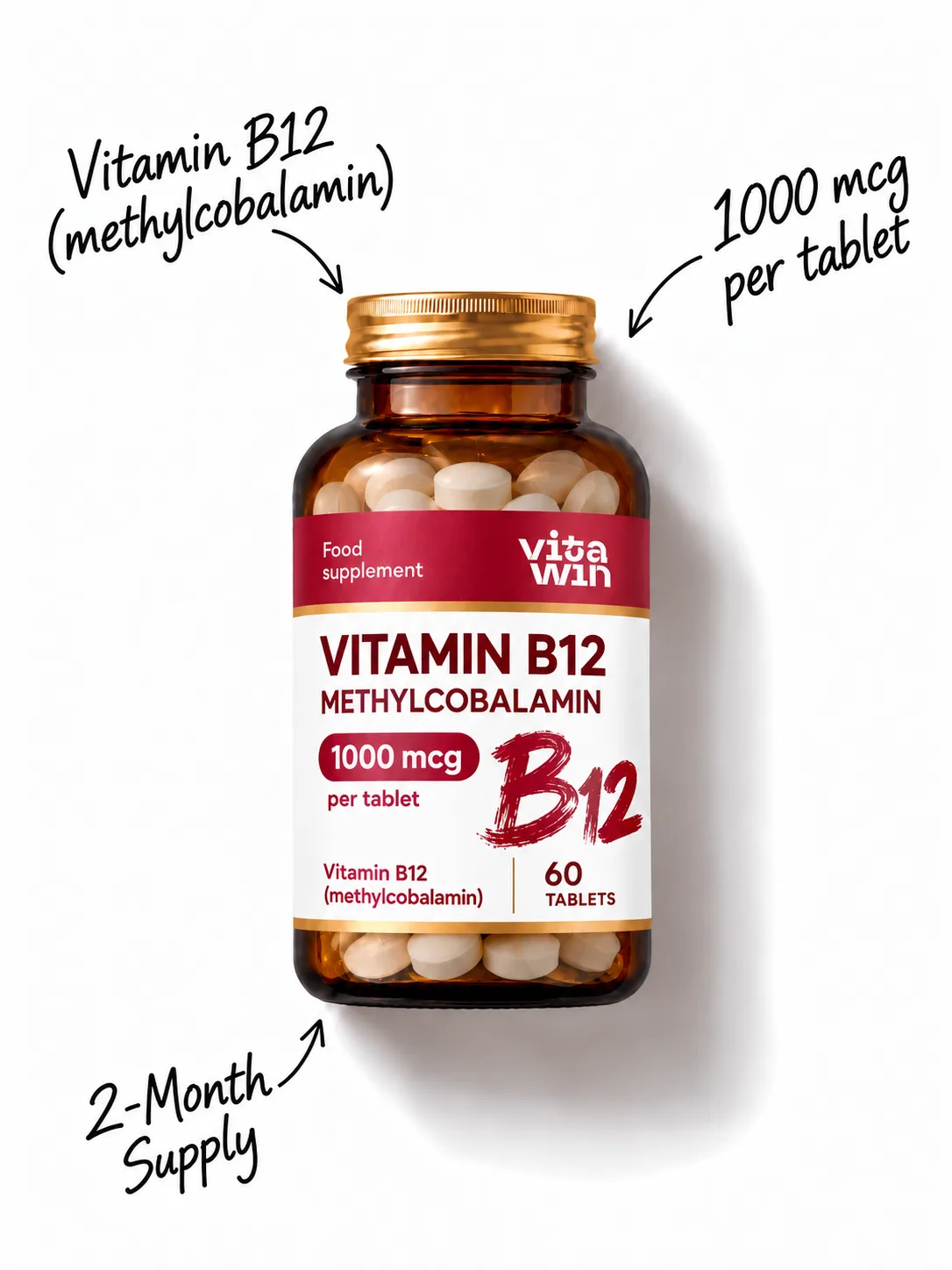
How to take vitamin B12 1000 mcg
One tablet a day with water, with or without food — B12 is water-soluble and does not need fat to be absorbed. Morning suits most people. Levels build over weeks; a blood test after three months is the only way to see where you have landed.
What is in each tablet
- Vitamin B12 (methylcobalamin) — 1000 mcg, 40000% NRV
- One tablet a day, any time
- 60 tablets — a two-month supply
Questions people ask
Is 1000 mcg too much?
No. B12 is water-soluble with no established upper limit, and the high dose compensates for the small fraction actually absorbed.
Daily or weekly?
Daily is simpler and keeps levels even. Weekly high-dose regimens exist but are usually prescribed, not self-chosen.
Do I still need it if I eat meat?
Usually not, unless absorption is the problem — age, medication or gut surgery. Browse the full vitamins range if you are unsure where the gap is.
Good to know. Do not exceed the recommended daily dose. Food supplements should not replace a varied, balanced diet and a healthy lifestyle. Talk to your doctor before use if you are pregnant, breastfeeding, taking medication or have a medical condition. Keep out of reach of children. Store in a cool, dry place away from direct sunlight.
These statements have not been evaluated by the Food and Drug Administration. This product is not intended to diagnose, treat, cure, or prevent any disease.