The problem most aspirants don’t talk about
Ask any aspirant three months before Prelims what is going wrong with their PYQ practice. They won’t say they haven’t solved the papers. Most have, more than once. They will say one of three things:
“I’ve done the last ten years of PYQs, but from four different answer keys — and two of them don’t even agree on the answer.”
“I know the right option. I couldn’t tell you why option (c) is wrong, and that is the one UPSC turns into next year’s question.”
“I solve PYQs year-wise, so I never see that Environment has asked about the same convention four times.”
None of this is a lack of effort. You already have the papers and you have already put in the hours. What is missing is one consistent source that explains every option and lays the questions out subject by subject. The Complete Package is that source.
Why PYQs are the highest-return hours before Prelims
UPSC does not repeat questions, but it keeps going back to the same themes, conventions, constitutional bodies and maps, and it builds the next question out of an option it used before. An aspirant who understands why each wrong option is wrong has, in effect, read the next paper’s options in advance.
This matters more in Prelims than anywhere else, because Prelims is decided by a few questions on either side of the cut-off. Elimination on multi-statement questions is where those questions are won or lost. The real bottleneck is not finding the papers. It is having every option explained, in one place, subject by subject.
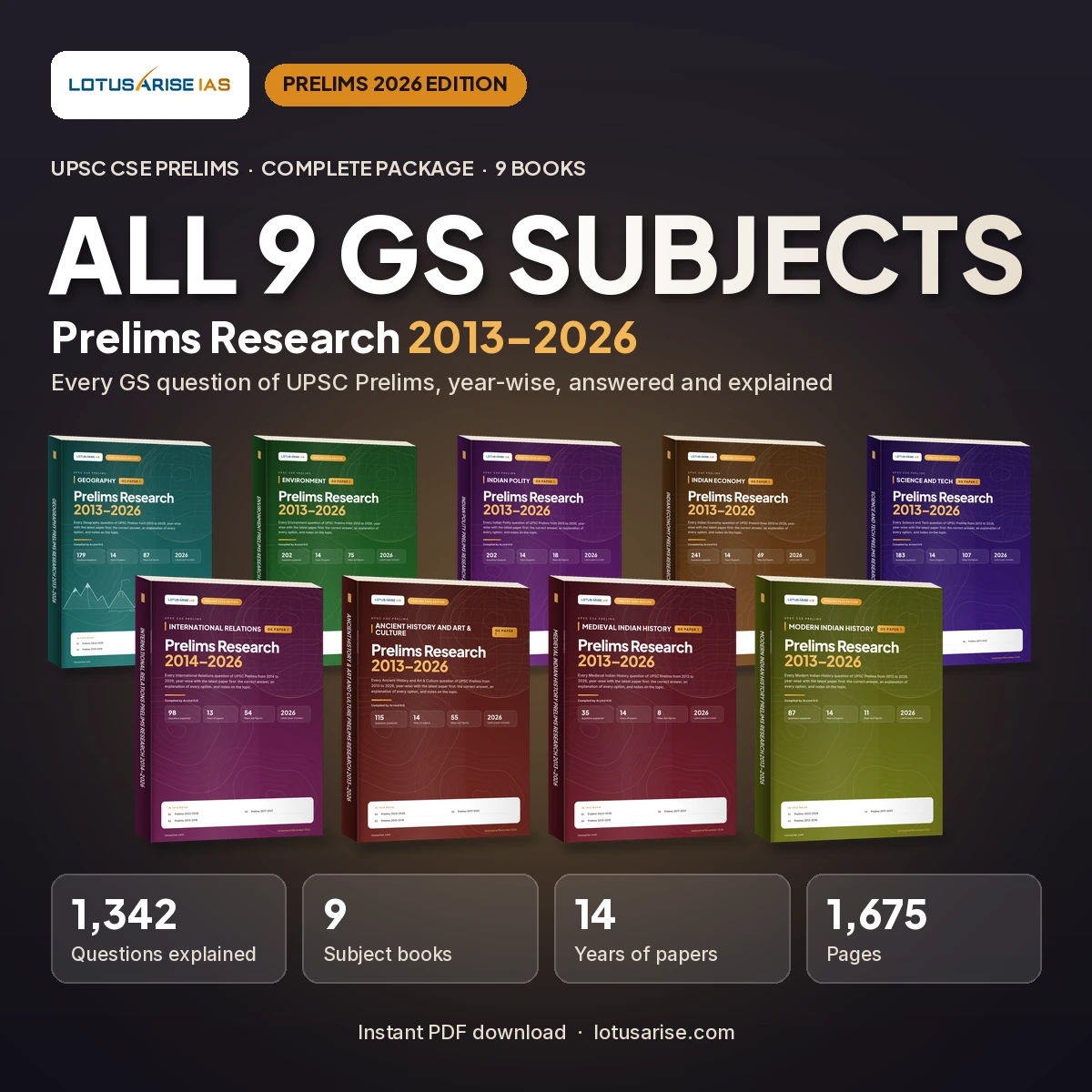
What’s inside — 9 books, 1,342 questions, 1,675 pages
Environment and Geography — 381 questions
- Climate conventions, biodiversity, protected areas, pollution and the reports UPSC keeps citing.
- Physical, Indian and world geography, with maps and diagrams for location-based questions.
Polity and Economy — 443 questions
- Constitution, constitutional and statutory bodies, governance and amendments.
- Macro concepts, banking, budget, agriculture and government schemes.
Science and Tech and International Relations — 281 questions
- Space, defence, biotechnology, IT and everyday science.
- International organisations, groupings, treaties and India’s bilateral ties.
History in three books — 237 questions
- Ancient History together with Art and Culture, Medieval Indian History, and Modern Indian History, each solved separately.
How every question is solved
Each solution gives the correct answer, then goes through every option: why it is right, or exactly where it fails. Multi-statement questions are broken down statement by statement. Questions are linked to the static topic and the current development that produced them, so the concept is what you remember, not the answer letter.
What makes this different from an answer key: an answer key tells you what UPSC marked correct. These books tell you why, for all four options, across 14 years of papers, in one consistent format.
The aspirant who buys this
First-time aspirants starting Prelims preparation and wanting to see what UPSC actually asks before reading a single standard book. The PYQs show you where to put your hours.
Repeaters who missed the cut-off by a few questions the content is already there. The gap is elimination on multi-statement questions, and that is what option-by-option solutions train.
Working professionals no batch schedule, no classes to attend. Nine PDFs you can open on your phone during a commute and print for weekend revision.
Self-study aspirants outside Delhi, Prayagraj and Jaipur the same PYQ analysis a coaching classroom would walk through, without the move or the fee.
State PSC aspirants the GS core of Polity, Economy, Geography, Environment and History is shared, and so is the way prelims papers set their traps.
Why not just use free answer keys and solutions?
Free solutions exist. Answer keys come out within days of every exam, and many explanation videos are good. If you already use them, keep using them.
The difference is not the answer — it is the system. Free keys give you the answer letter, sometimes a line of reasoning, and they disagree with each other on the hard questions. They are year-wise, scattered across sources, and rarely explain the three options you did not pick. These books put 14 years of papers into nine subject-wise volumes with every option explained in the same format.
If you have the discipline to collect, reconcile and annotate 14 years of solutions yourself, you may not need this. If you want that work already done — open the Environment book tonight and start — this is what the package is for.
The price
Bought separately on the LotusArise store, the nine books come to ₹826.
The Complete Package: ₹590 — about 44 paise per solved question.
- One-time payment. No subscription. No recurring charge.
- Clicking Buy takes you to store.lotusarise.com, where you pay and download.
- Your download link arrives by email immediately after payment (check your spam folder if you don’t see it).
- Nine separate PDFs: readable on laptop, mobile and tablet, offline, and print-friendly.
- Support: support@lotusarise.com