About this product
The name Opal came from the Latin “opalus”, meaning “precious stone”. Opal can easily be dehydrated by heat or chemical exposure. Precious opal is extremely rare and fine examples are more expensive than diamond, especially black opal. More than 95% of the world’s opal comes from remote central Australia, namely black opal from Lightning Ridge, and white, crystal and matrix from South Australia.
Opal is a hydrated silica or amorphous form of silica chemically similar to quartz, but displaying dazzling colors. Opal is made up of layers of precipitated silica spheres in a jelly-like water mass, and the ordering of the spheres sometimes produce a diffraction grating, that creates a play of rainbow sparkling light from within the stone.
There are fundamentally three types of opal: precious opal (containing flashes of fire), the yellow-reddish “fire opal” which is named for its color (not flashes of fire), and common opal (sometimes called “potch”).
“Common opal” is rarely transparent, but may be colored or contain inclusions. It is used as backing for the more desirable varieties of precious opal, but may also be cabbed to produce interesting stones. It comes in white, gray, yellow, blue, green, pink, and may be dendritic or contain moss.
“Fire opal” is named for its fiery red color, and not the flashes from within. Today most fire opal comes from Mexico and is often cut into faceted gem stones. It runs from a deep red to many shades of orange and even on to yellow. It may have a few flashes of fire, but usually it is sold for the color and clarity. It is not particularly expensive as it suffers from the same physical characteristics as all opal, and contains little of the desired color flash.
Show allShow less
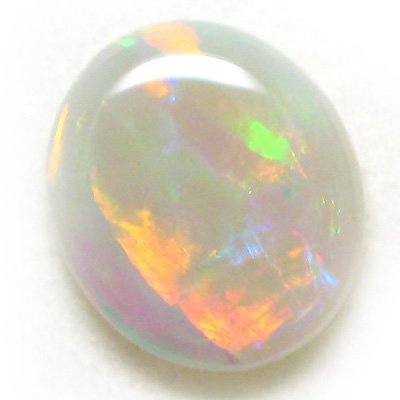
“Precious Opal” – this is the material with the internal “color play”, “flash”, or “light show”. It is classified by its back ground color, the particular colors and intensity of color display, and its size. Stones that are predominantly white or light blue are the most common, and those that contain reds, oranges, and violets are considered more desirable. Blue and green are very common in most precious opal. Black opal, opal containing a predominantly dark background (dark-gray to blue-black) is the rarest, and most desired of all opals. When it contains reds and oranges it brings even a higher value. It may be priced right up with the top gemstones (diamond, emerald, and ruby). The very best black opal came from Lightening Ridge. Australia and small amounts till reach the market today, but there have been no major finds in many years.
Another “collectors” variety is called “contra luz”. It shows the desired play of color, but only when light is transmitted through the stone. It appears to be clear when viewed from the same side. It is thus very difficult to design jewelry using this variety and it finds its way mainly into collections. “Hydrophane” is a variety that losses its water to become opaque, but can regain it’s water and become transparent with color flash, again mainly a collectors stone.
In Realgems's own words. See it at Realgems