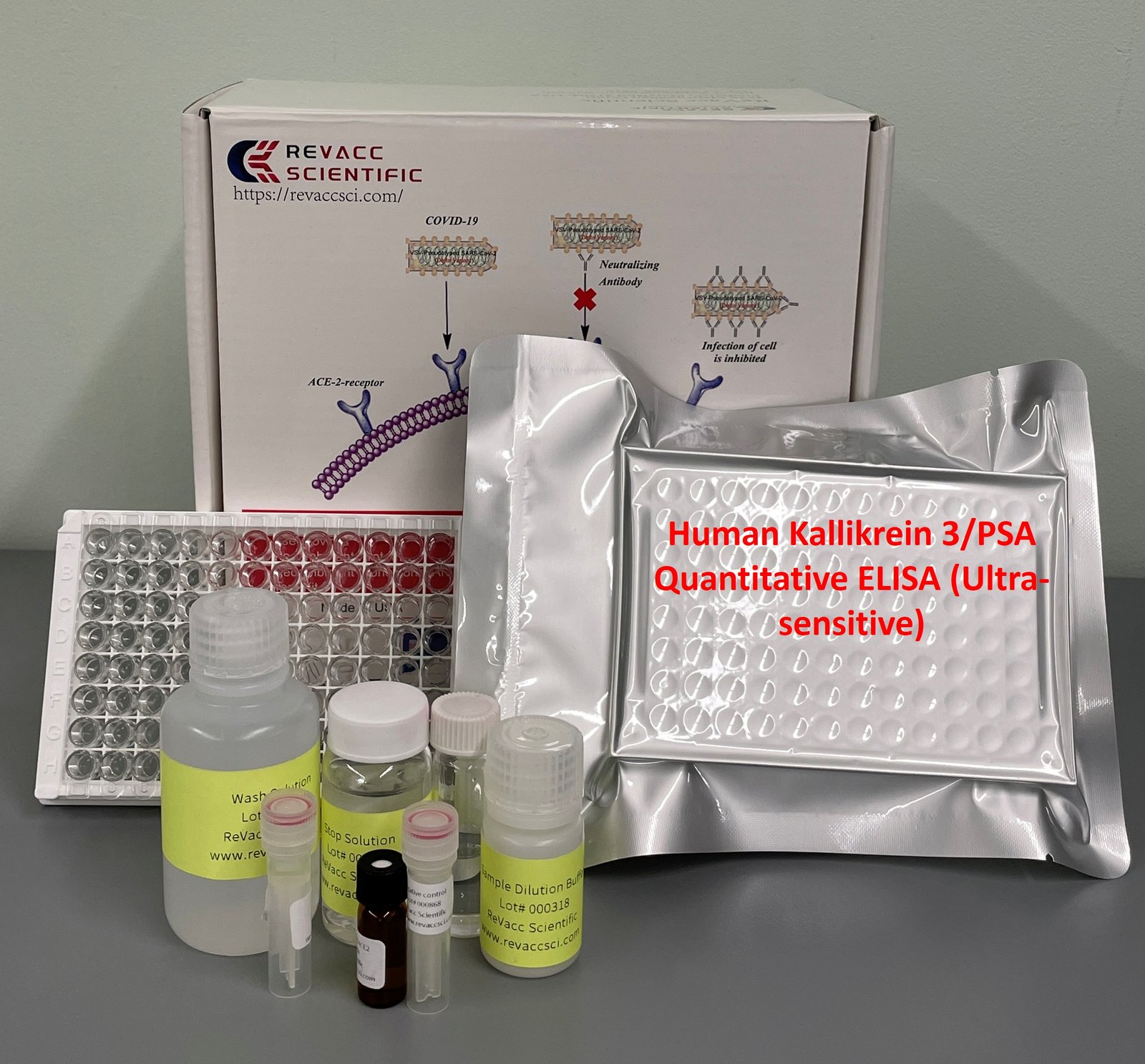
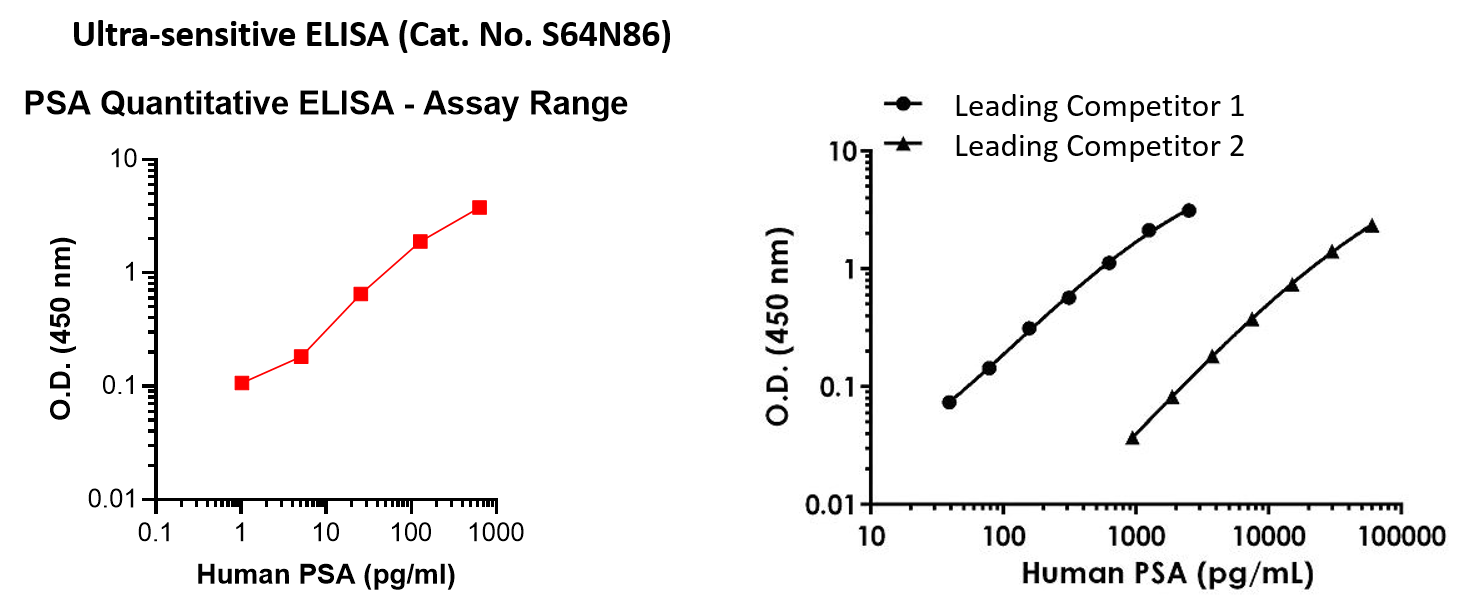
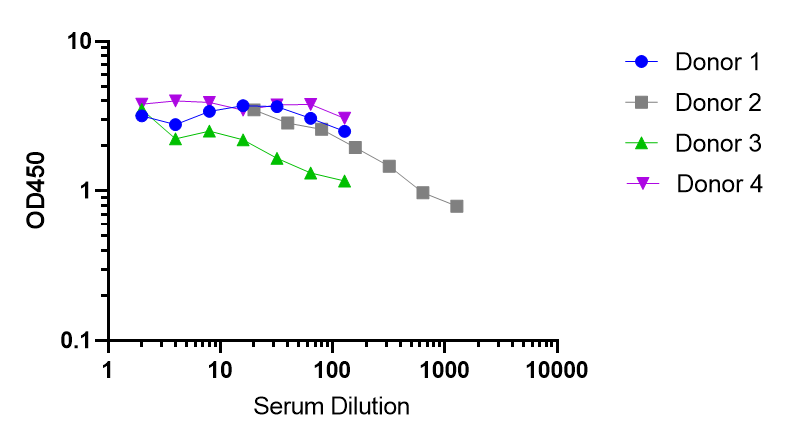
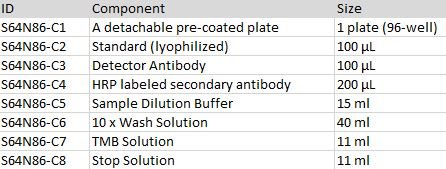
This kit was designed for a 3.5 hour solid phase immunoassay to measure the levels of human Kallikrein 3/Prostate Specific Antigen (KLK3/PSA) concentrations in cell culture supernates, serum, plasma or other biological fluids. The recombinant human KLK3/PSA (lyophilized) serves as the standard, antibodies against PSA used to detect, and HRP labeled secondary antibody to amplify the signal, resulting in lower minimum detectable dose (ultra-sensitive), compared with other competitors. Natural human KLK3/PSA showed dose-response curves that were parallel to the standard curves obtained using the kit standard, indicating that this kit can be used to determine relative levels of natural human KLK3/PSA.
Applications:
This kit is developed to measure the levels of human Kallikrein 3/Prostate Specific Antigen (KLK3/PSA) concentrations in cell culture supernates, serum, plasma or biological fluids. It is for research use only.
Description:
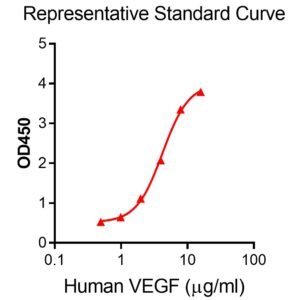
These kits were tested to compare the assay range with other competitors and measure the concentration of PSA in serum and plasma, see figures. The detection linear range is 1-640 pg/ml; Sensitivity is 1 pg/ml.
Note: Cell culture supernates or other biological fluids have not been validated for use in this assay.
Biosafety Level:
BSL-1
Organism:
Human Kallikrein 3/Prostate Specific Antigen (KLK3/PSA)
Assay Principles:
This kit is developed for a sandwich ELISA format, providing a rapid measurement (3.5h) of KLK3/PSA. The kit consists of a detachable 96-well pre-coated plate. Standards and samples are pipetted into the wells and any human PSA present is bound onto the plate. After removing any unbound substances, a detector antibody specific for human PSA is added to the wells. After washing to remove any unbound antibody reagent, HRP labeled secondary antibody is added to target the bound antibody to amplify the signal, facilitating a lower minimum detectable dose measurement. After adding HRP Substrate (TMB), TMB turns blue under the catalysis of HRP, and turns yellow after adding stop solution. Measure the OD value with a microplate reader at 450 nm wavelength. Then the concentration of KLK3/PSA is proportional to the OD450 nm value.
Brief protocol (the detailed steps are provided with the product):
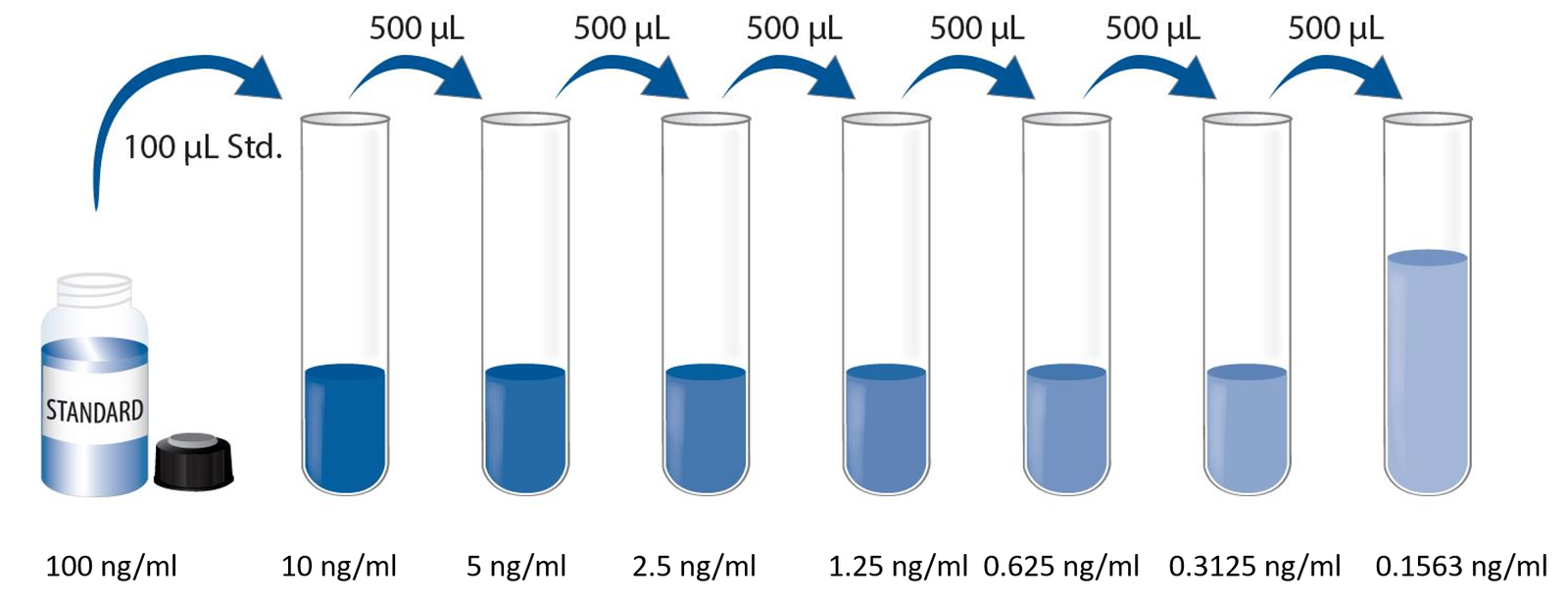
- Detach wells from plate based on your samples and keep at room temperature. Dilute your samples or reconstituted standards in sample dilution buffer and add them to wells (0.1 ml/well). Incubate at 37°C for 1 hour or room temperature for 1.5 hour. Wash wells 4 times by wash solution (0.3 ml/well)
- Add detector antibody to wells (0.1 ml/well). Incubate at 37°C for 1 hour or room temperature for 1.5 hour. Wash wells as mentioned.
- Dilute the HRP secondary antibody in wash solution and add to each well (0.1 ml/well). Incubate at room temperature for 0.5-1 hour. Avoid light by foil. Wash wells as mentioned.
- Add TMB to each well (0.1 ml/well) and incubate at room temperature for 10-30 minutes. Protect from light.
- Stop the substrate reaction by adding stop solution (0.1 ml/well). Absorbance (OD) is calculated as the absorbance at 450 nm.
Storage and shipping condition:
Shipment with room temperature. The unopened kit is stable for 6 months from the date of manufacture when stored at 2°C to 8°C. Avoid light. The shelf life is 60 days from the date of opening.
Recommendations:
Customers who need additional components can find individual component (Cat. No. R50K36).
References:
- Lovgren, J., et al., Measurement of prostate-specific antigen and human glandular kallikrein 2 in different body fluids. J Androl, 1999. 20 (3): p. 348-55.
- Lilja, H., A.T. Cockett, and P.A. Abrahamsson, Prostate specific antigen predominantly forms a complex with alpha 1-antichymotrypsin in blood. Implications for procedures to measure prostate specific antigen in serum. Cancer, 1992. 70 (1 Suppl): p. 230-4.
- Lilja, H., A kallikrein-like serine protease in prostatic fluid cleaves the predominant seminal vesicle protein. J Clin Invest, 1985. 76 (5): p. 1899-903.
- Stenman, U.H., et al., A complex between prostate-specific antigen and alpha 1-antichymotrypsin is the major form of prostate-specific antigen in serum of patients with prostatic cancer: assay of the complex improves clinical sensitivity for cancer. Cancer Res, 1991. 51 (1): p. 222-6.
- Catalona, W.J., et al., Evaluation of percentage of free serum prostate-specific antigen to improve specificity of prostate cancer screening. JAMA, 1995. 274 (15): p. 1214-20.
- Obiezu, C.V., et al., Serum and urinary prostate-specific antigen and urinary human glandular kallikrein concentrations are significantly increased after testosterone administration in female-to-male transsexuals. Clin Chem, 2000. 46 (6 Pt 1): p. 859-62.