The International Relations problem nobody admits before Prelims
Ask an aspirant a month before Prelims how International Relations is going. They will not say they haven’t read it. They will say one of three things:
“I know BRICS expanded. In the paper I still can’t say whether Indonesia came in as a member or a partner, or in which year.”
“NSG, MTCR, Wassenaar, Australia Group. ICJ, ICC. NDB, AIIB. IORA, IONS. They all blur together in the exam hall.”
“I have 1,000 pages of IR notes, a current affairs magazine and four weeks. I can’t reread all of it, and I don’t know what to drop.”
None of these is a memory problem. International Relations is a subject of sets, look-alike acronyms and facts that change every year, and most notes give every page the same weight. What is missing is a filter: a way to know which facts UPSC actually asks, and to revise those first. International Relations Prelims Summary Notes is that filter, built from the questions themselves.
Why the questions are the right place to start
International Relations has been part of every Prelims paper for three decades: about 6.6 questions a paper before 2011 and 5.3 since, a share that has risen a little as the paper shrank to 100 questions. 2026 set the record with 16 questions.
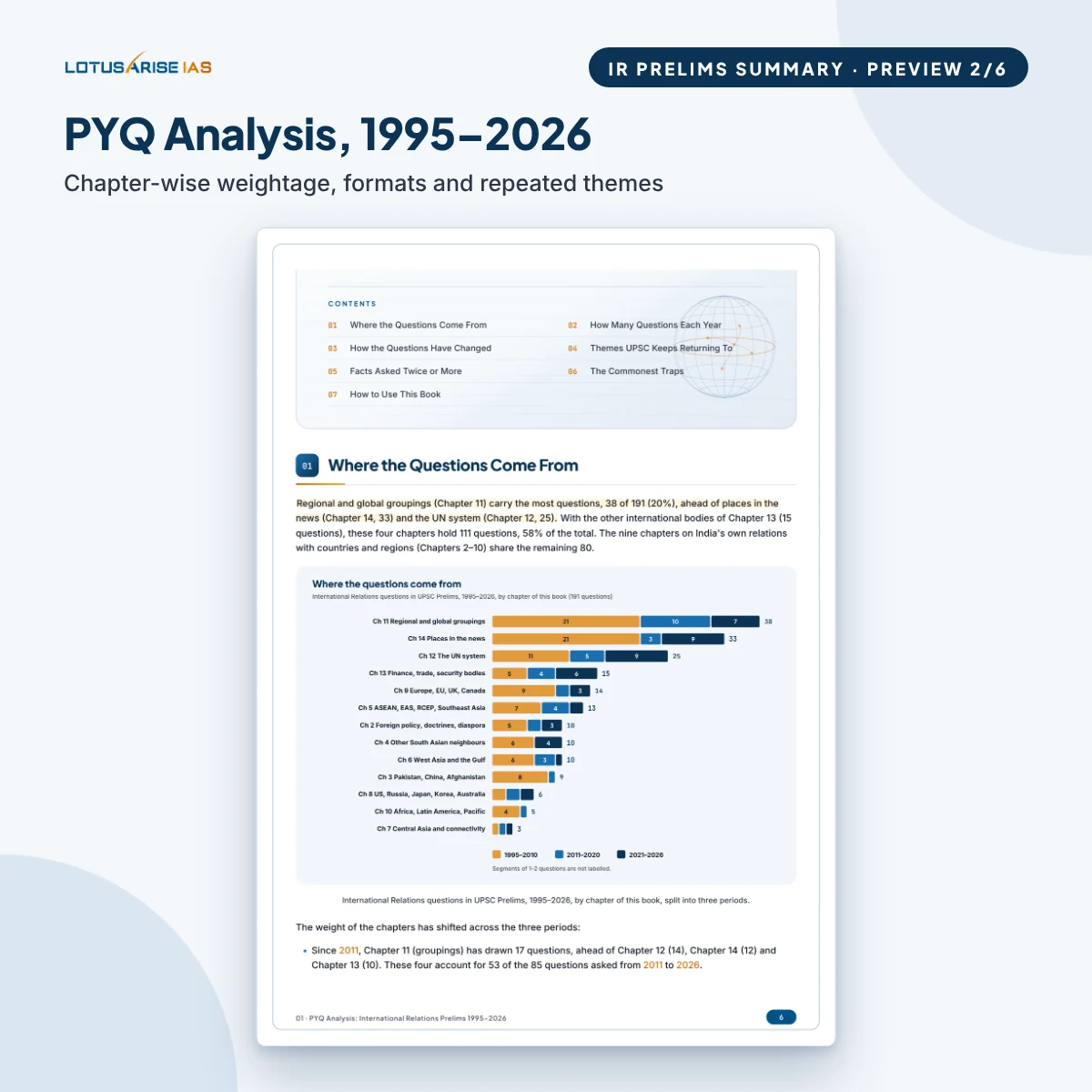
The questions are also more predictable than they look. Four chapters (groupings, places in the news, the UN system and the other international bodies) hold 111 of the 191 questions. The same themes keep coming back: who belongs to which grouping, where a body is headquartered, India’s exact status, which region a conflict is in. The format has changed sharply. The single-answer question has nearly gone, and since 2021, 36 of 47 questions asked you to judge every statement or pair, so one question now tests a body’s members, headquarters, founding year and India’s status together.
The challenge is not the subject. It is knowing which facts the paper keeps returning to, and having them in one place, updated.
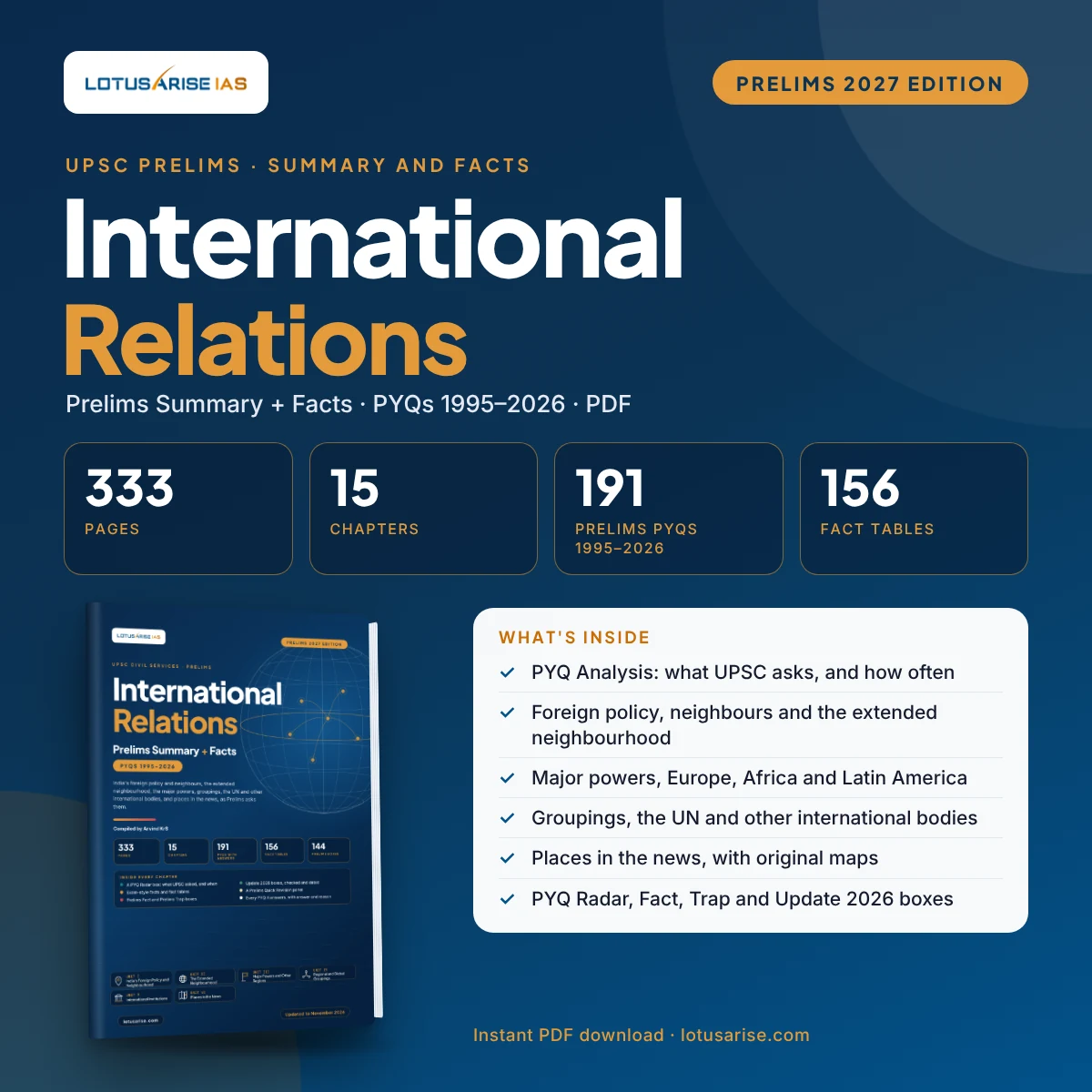
What’s inside — 333 pages, 15 chapters
📊 Chapter 1: PYQ Analysis, 1995–2026
- Chapter-wise weightage of all 191 questions, split into 1995–2010, 2011–2020 and 2021–2026, with charts
- Questions per year, and how the question formats changed
- The themes UPSC keeps returning to, with counts and what exactly is asked
- The facts asked twice or more, and the commonest traps in IR questions
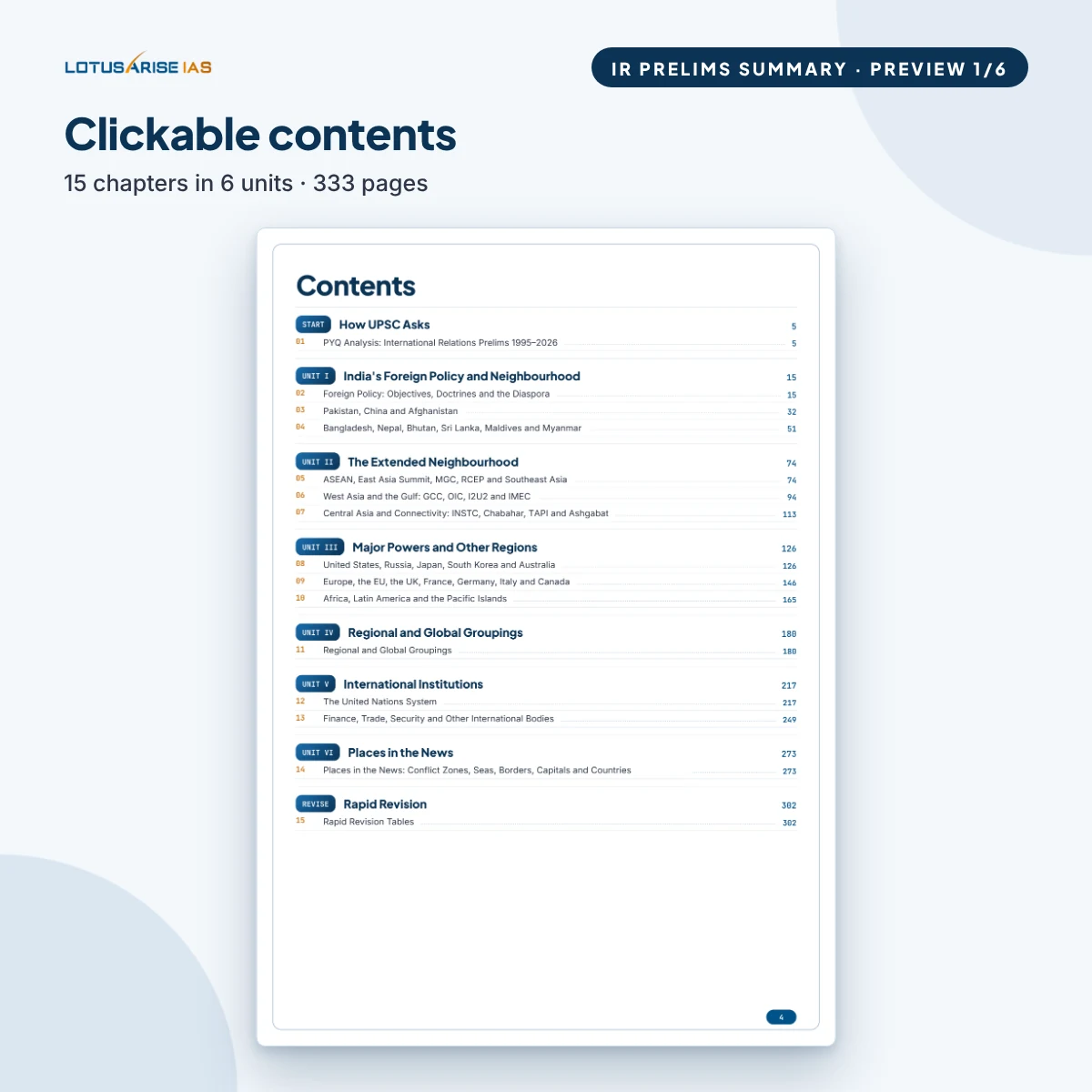
📚 13 fact chapters in six units
- India’s foreign policy and neighbourhood objectives, doctrines (Panchsheel to Neighbourhood First), the diaspora; Pakistan, China and Afghanistan; Bangladesh, Nepal, Bhutan, Sri Lanka, the Maldives and Myanmar
- The extended neighbourhood ASEAN, the East Asia Summit, MGC and RCEP; West Asia, the GCC, OIC, I2U2 and IMEC; Central Asia, INSTC, Chabahar, TAPI and the Ashgabat Agreement
- Major powers and other regions the US, Russia, Japan, South Korea and Australia; Europe, the EU, the UK, France, Germany, Italy and Canada; Africa, Latin America and the Pacific Islands
- Regional and global groupings BRICS and the NDB, SCO, G7, G20, Quad, AUKUS, SAARC, BIMSTEC, IORA, IONS, the Colombo Security Conclave, NAM, G77, OPEC and the export control regimes
- International institutions the UN system and its agencies; the World Bank group, IMF, WTO, ADB, AIIB, the arms control bodies, Interpol and more
- Places in the news conflict zones, straits, seas, borders, capitals and countries, with maps
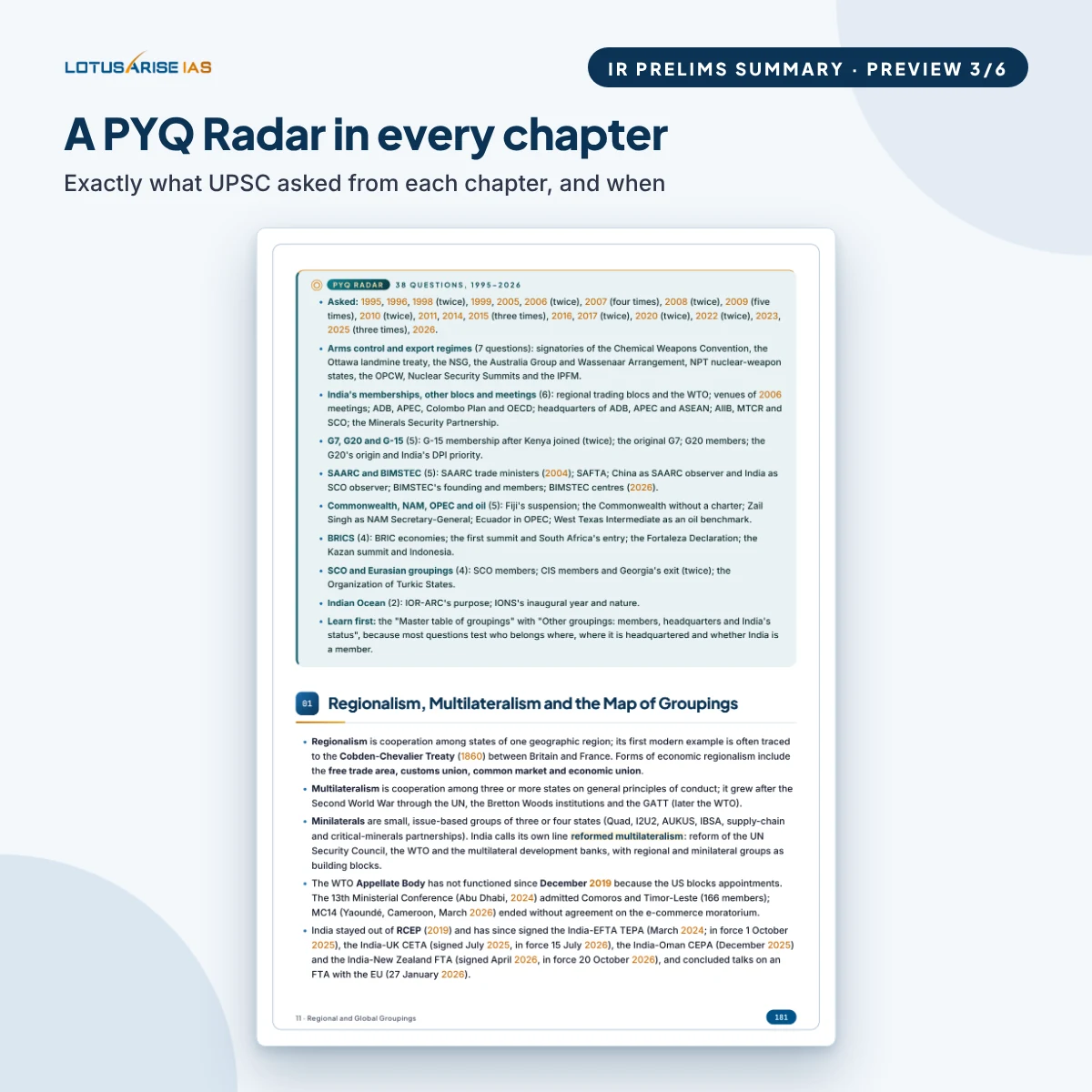
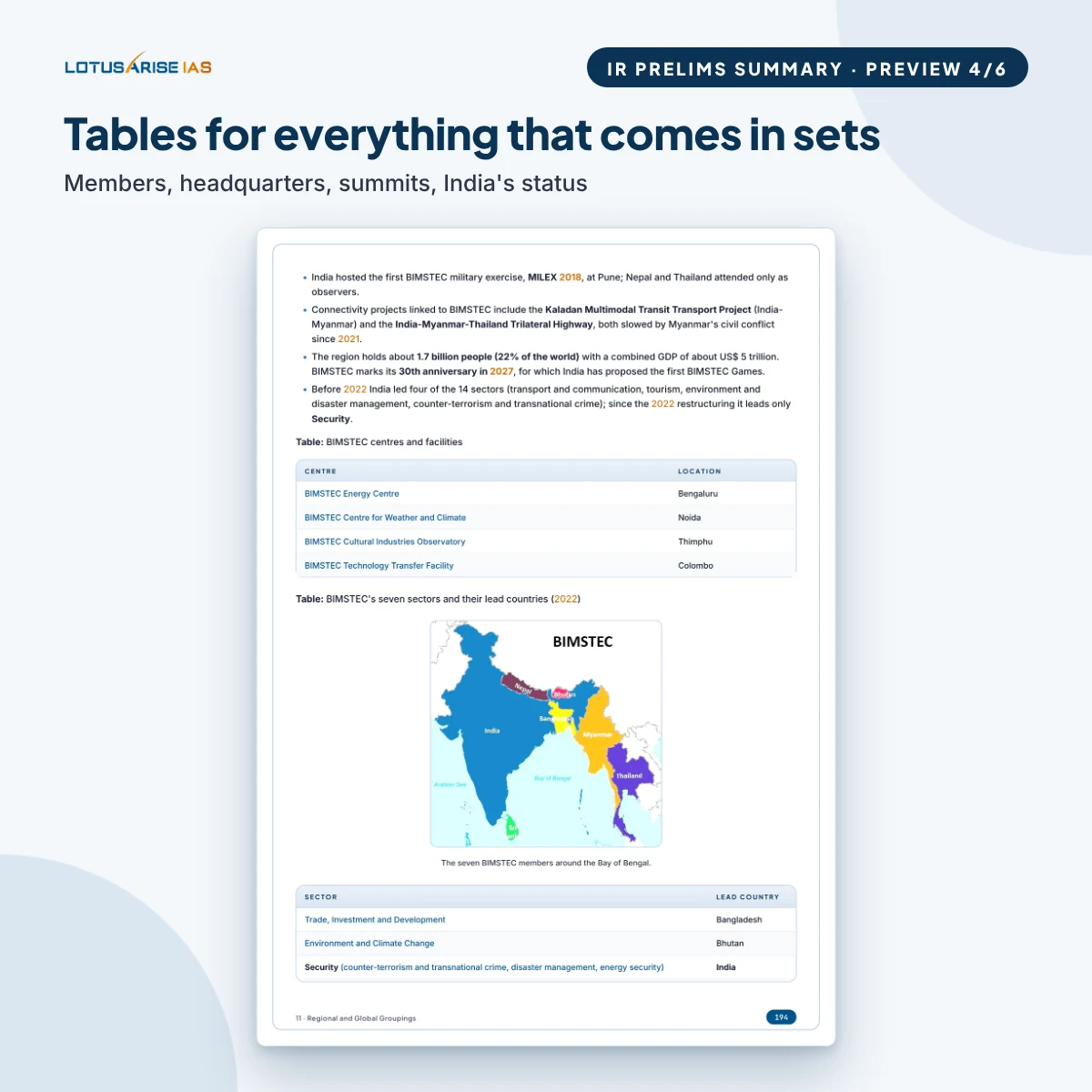
What makes this different from downloaded summary PDFs each chapter opens with a PYQ Radar that tells you what UPSC asked from it and in which years, so you know where to spend your time before you read a line. The facts are written the way a correct statement reads in a Prelims question, and anything that comes in a set (grouping and members; body, headquarters and year; summit and host; exercise and partner; corridor and route) is a table. Every chapter was written, then checked fact by fact by a separate reviewer against official sources (MEA, PIB, the UN and each body’s own site), with time-sensitive facts dated.
🎯 191 Prelims PYQs, each where it belongs
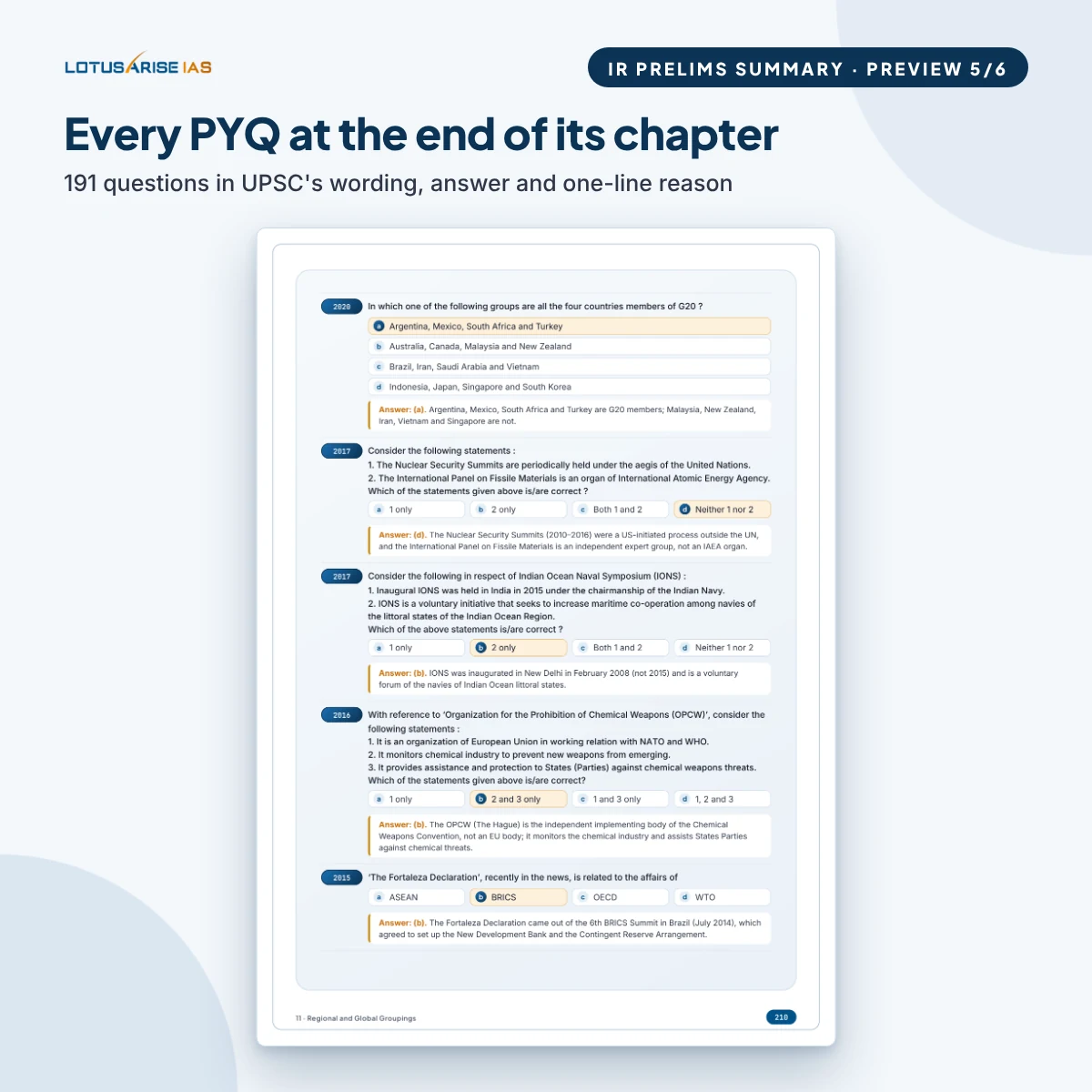
Every International Relations question from 1995 to 2026, in UPSC’s wording, placed at the end of the chapter that answers it, with the right option marked and a one-line reason. Answers for 2011–2025 follow UPSC’s official keys and 2026 follows UPSC’s provisional key, marked as such. For 1995–2010, the answers are the agreed answers from solved papers, each checked against the facts, and the few with disputed keys are flagged.
🧩 144 Prelims Fact, Trap and Update 2026 boxes
The Trap boxes take on the look-alikes UPSC builds options from: G4, G7 and G20; NSG, MTCR, Wassenaar and the Australia Group; UNHRC and UNHCR; ICJ and ICC; NDB and AIIB; IORA and IONS; SCO and CSTO; Look East and Act East; INSTC, Chabahar and Kaladan; IBRD and IDA. The Update 2026 boxes carry dated changes: new BRICS and SCO members, the 2026 summits and their hosts, new heads of UN bodies, trade agreements that came into force, and the conflicts in the news.
🗺️ 25 original maps
Drawn for this book on India’s official boundaries: India’s neighbourhood and frontiers, the Palk Strait, Southeast Asia, the Gulf and IMEC, Central Asian corridors, Africa, Latin America, the Pacific Islands, BRICS, the Indian Ocean, UN peacekeeping, NATO and CSTO, and the chokepoints, the Black Sea, the Levant and Red Sea, the Balkans and the Sahel for places in the news.
🗂️ Rapid Revision Tables — 32 pages
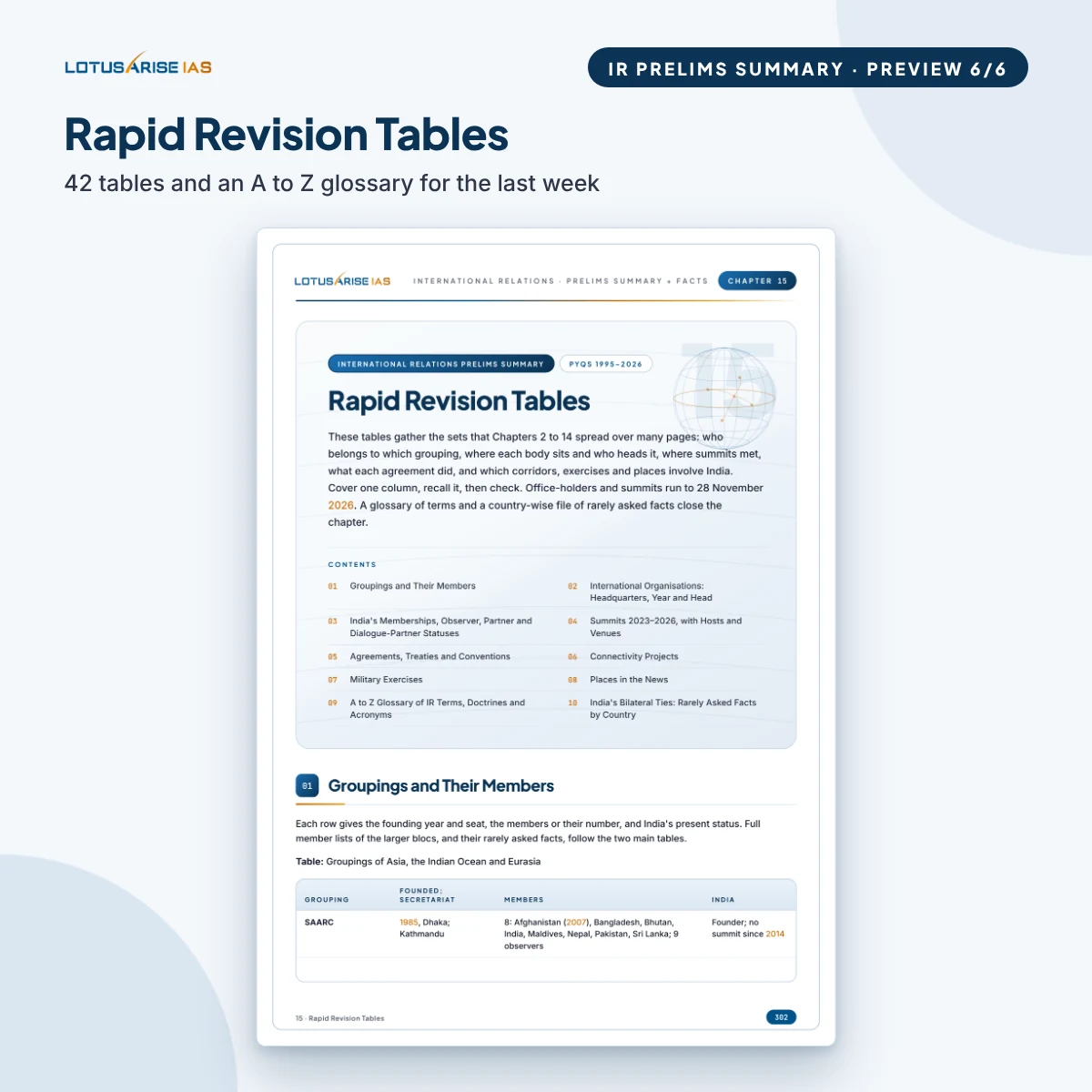
42 tables for the last week: groupings and their members; organisations with headquarters, year and present head; India’s memberships, observer and partner statuses; summits 2023–2026 with hosts; agreements, treaties and conventions; connectivity projects; military exercises; places in the news; and an A to Z glossary of IR terms and acronyms.
The aspirant who buys this
Prelims 2027 aspirants in revision mode you have read International Relations once and need a version that puts what UPSC asks first.
Repeaters you keep losing marks on “how many” questions about groupings and bodies, or on regions in the news. The PYQ Radar and the Trap boxes are built for exactly that.
First-time aspirants you want to see, before you open a long book, which parts of the subject the paper actually tests.
State PSC aspirants groupings, institutions and India’s neighbours are in every State PSC paper, and the tables serve both.
Why not just solve the PYQs from a free list?
Free PYQ lists exist, and they are useful. But a list of questions only tells you what was asked once. It does not give you the other members of each set, the facts behind the wrong options, or what has changed since the question was set, and it is ordered by year, not by topic.
This book answers each question inside the chapter that teaches it, and then gives you the whole set UPSC could ask next, updated to November 2026. If you want the full notes with every relation and institution explained at length for Prelims and Mains, the companion International Relations Notes for UPSC (1,013 pages, ₹236) is the complete book. This summary is the version you revise from.
Price and delivery
₹149 for 333 pages — about 45 paise a page, and less than most aspirants spend on a single printed guide.
Want to see it first? Download the free sample PDF — the cover, the full contents and three complete chapters: Chapter 1 (PYQ Analysis), Chapter 11 (Regional and Global Groupings) and Chapter 12 (The United Nations System).
One-time payment. No subscription. No recurring charge.
Instant PDF download after payment. The download link is also sent to your email — please check the spam folder if it does not arrive in a few minutes. Download it again any time from My Account.
For support: support@lotusarise.com