“I can describe Davis and Penck, but when UPSC says ‘landscape is a function of structure, process and stage’ and asks for a critique, I have a summary and no argument.”
“Geomorphology and Climatology I have covered. Oceanography and Biogeography I keep for the end, and they still come in the paper.”
“My diagrams are from one place, my El Niño notes from another, and I cannot tell which of my facts have gone out of date.”
None of this is a lack of effort. The five branches are scattered across thick books written decades apart, in different orders and at different depths. What is missing is one set that takes all five the same way, from theory to the questions UPSC has actually asked. Physical Geography: Geography Optional Notes is that set.
Why this section is a smart place to spend your hours
No branch here is safe to skip. Our own count of the ten papers from 2017 to 2026, with each sub-part as one question: Geomorphology 35 questions and 515 marks, Environmental Geography 33 and 470, Climatology 30 and 465, Oceanography 24 and 315, Biogeography 20 and 265. All five were asked in every one of those ten years.
UPSC also asks old theory and new events side by side. The 2018 paper wanted a critique of Davis. The 2026 paper wanted “pseudo monsoon” defined, and the 2025 paper asked about deep-sea mining.
It pays back in Paper II as well. The 2026 question on El Niño and the Indian monsoon sits in Climatology and again under Paper II’s Physical Setting. Soil erosion and marine resources return in Paper II too. Learn the mechanism properly once and you use it in both papers.
The challenge is not the theory. It is having one current account of all five branches that you can actually revise.
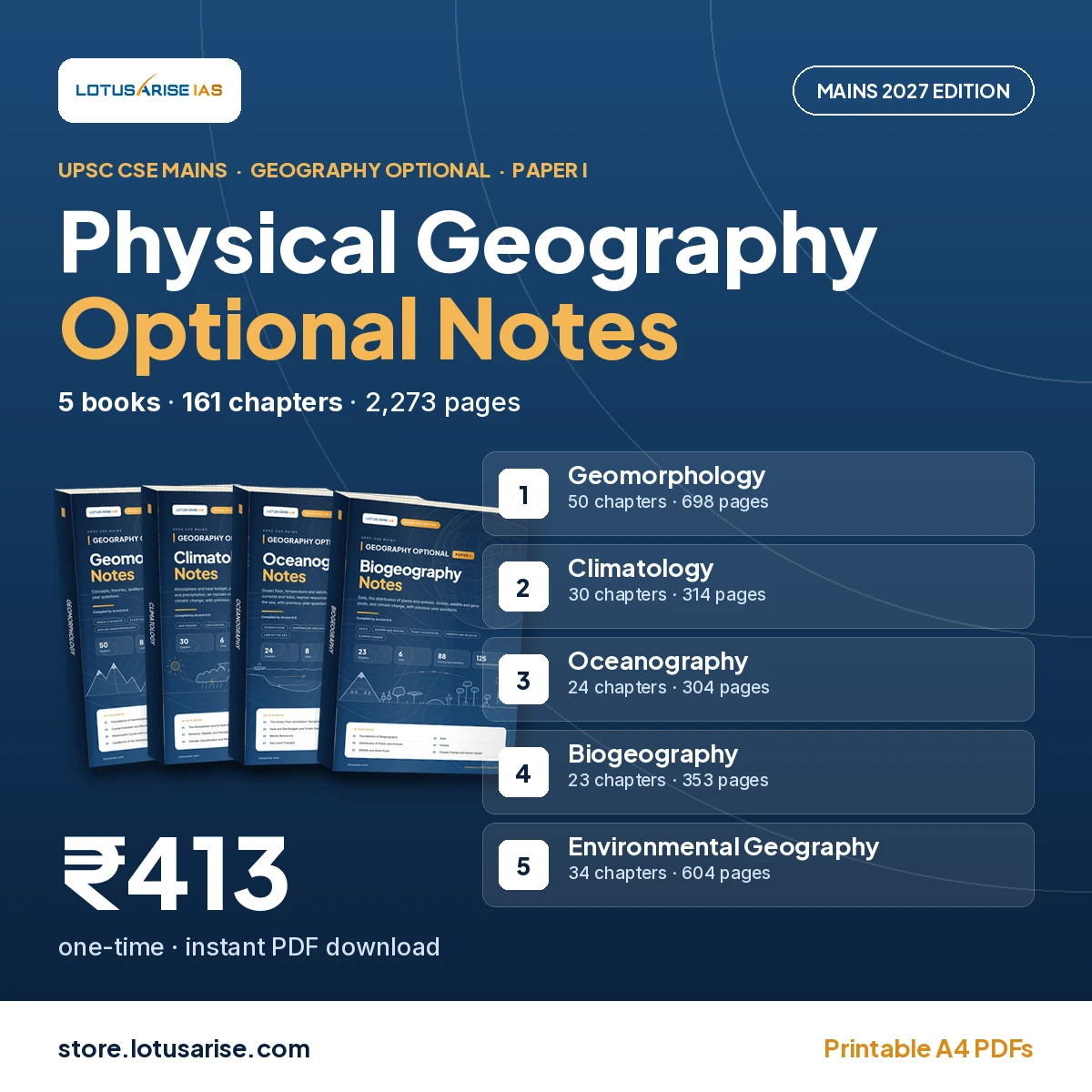
What’s inside — 2,392 pages in 5 books
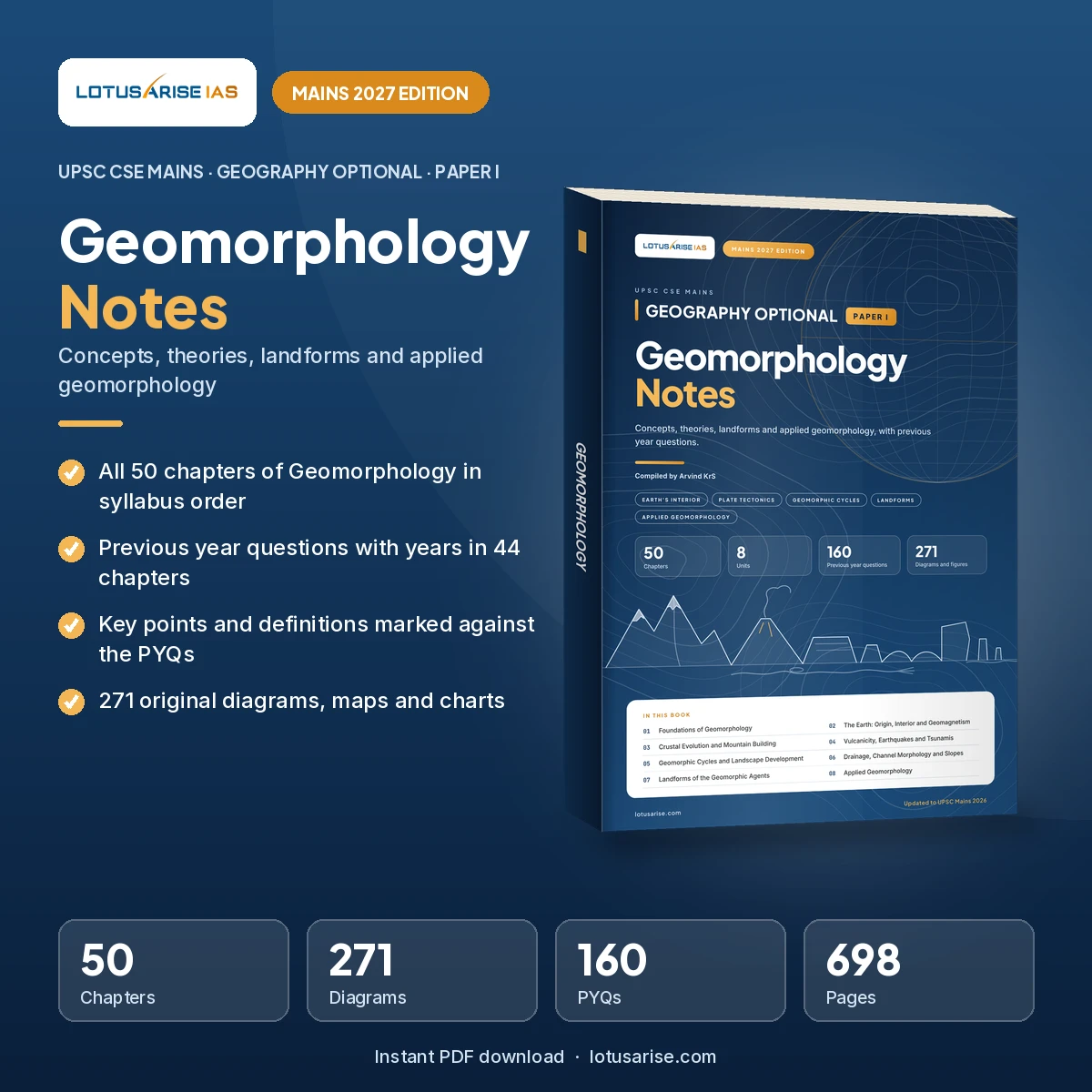
🏔️ Geomorphology — 728 pages, 50 chapters, 160 PYQs
Earth’s interior and geomagnetism, continental drift, isostasy, plate tectonics, Davis and Penck, denudation chronology, channel morphology, slope models, landforms of each agent and applied geomorphology.
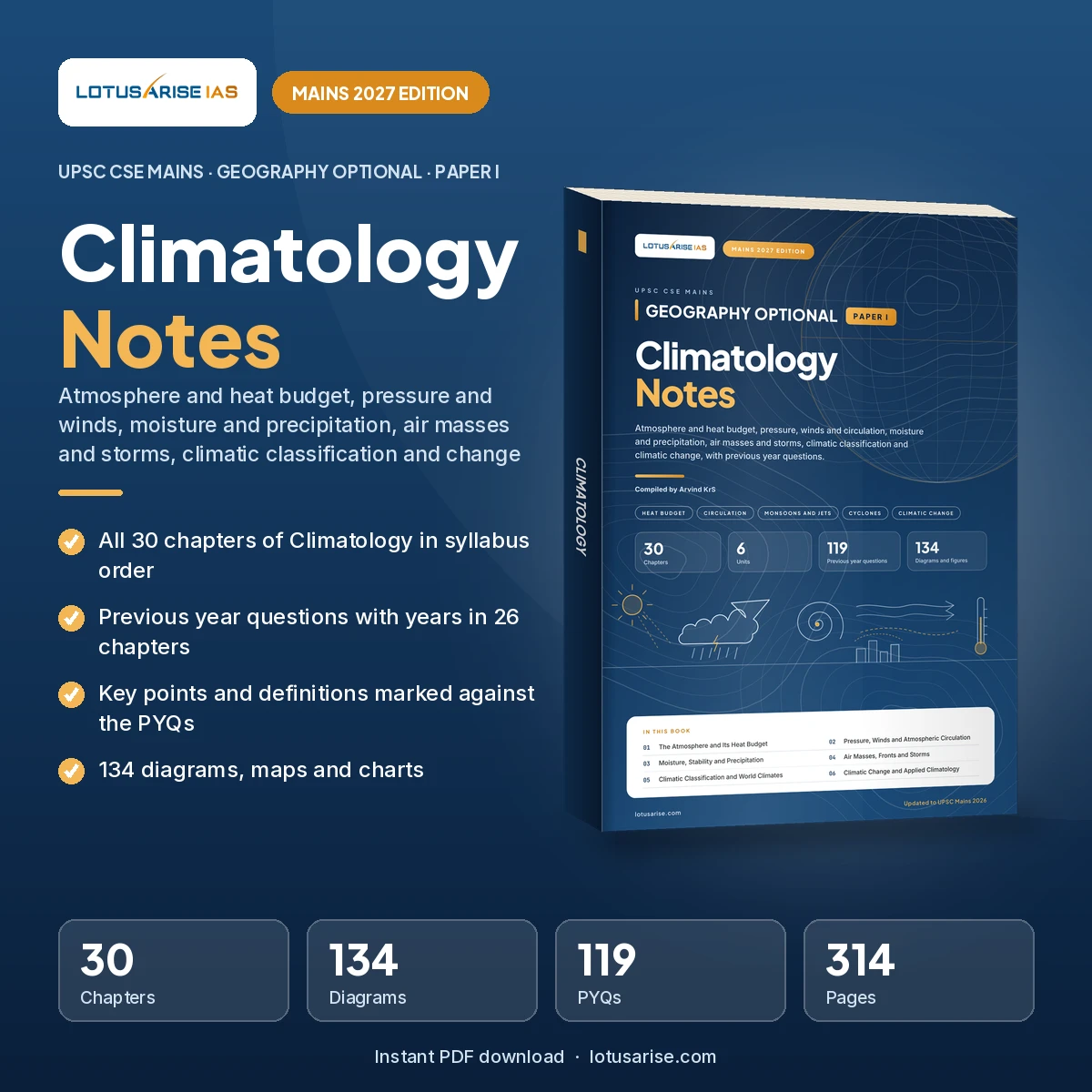
🌦️ Climatology — 335 pages, 30 chapters, 119 PYQs
Heat budget, pressure belts, jet streams, monsoon theories, air masses and fronts, temperate and tropical cyclones, Köppen, Thornthwaite and Trewartha, global warming and urban climate.
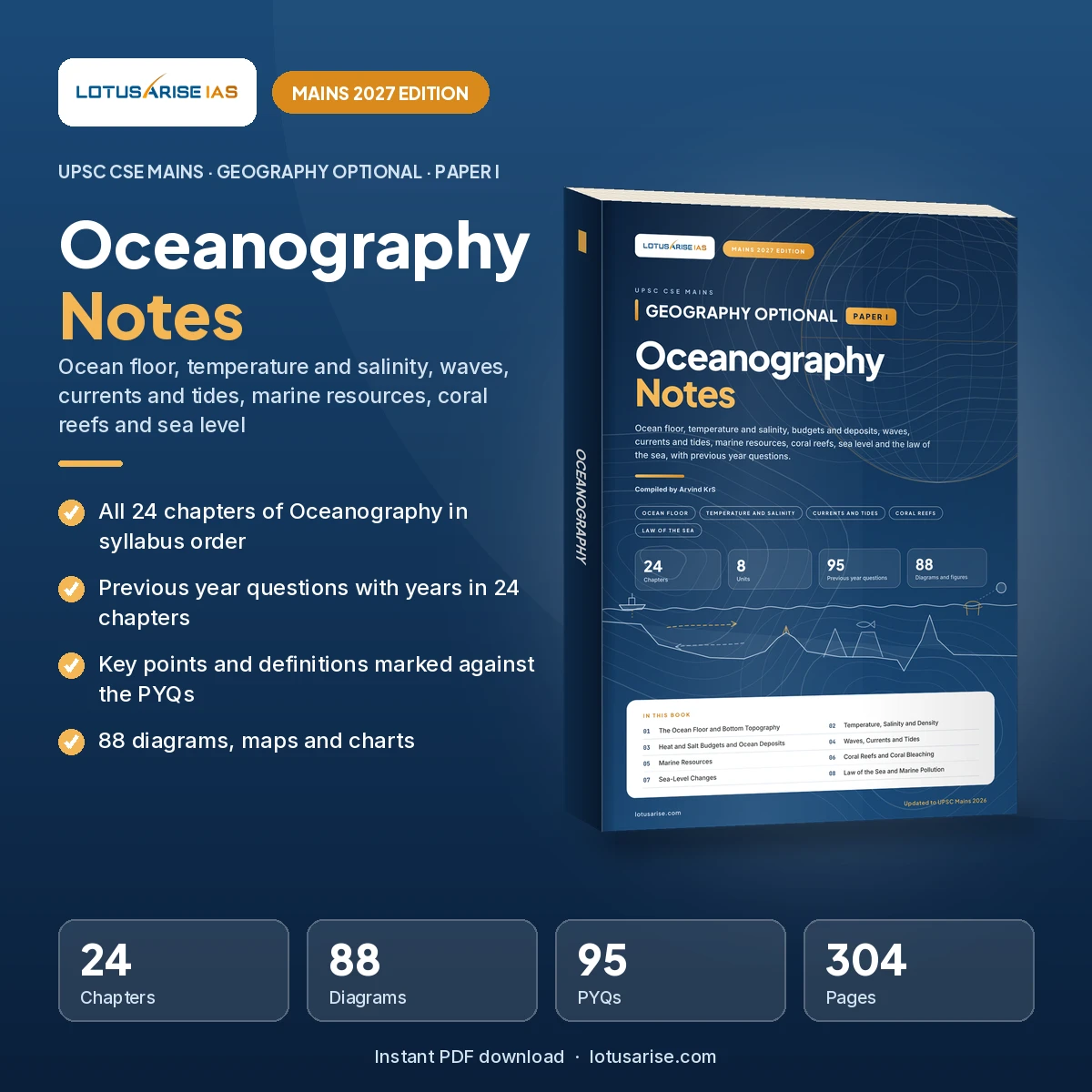
🌊 Oceanography — 326 pages, 24 chapters, 95 PYQs
Bottom relief of the Atlantic, Pacific and Indian Oceans, salinity and T-S diagrams, heat and salt budgets, ocean deposits, currents and gyres, the AMOC, marine resources, coral reefs and bleaching, sea-level change and UNCLOS.
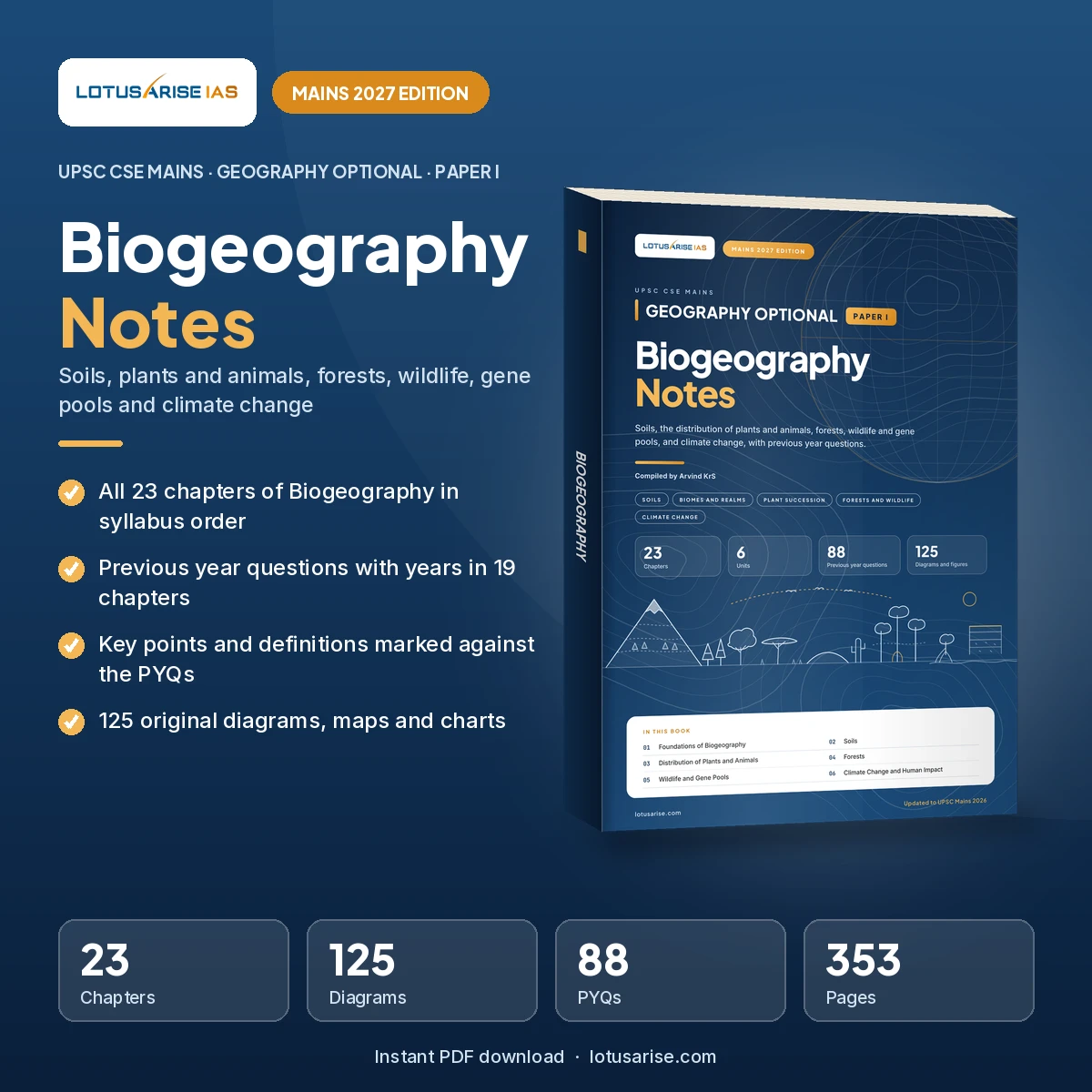
🌱 Biogeography — 368 pages, 23 chapters, 88 PYQs
Pedogenesis, soil profiles and classification, soil erosion, biomes, plant succession, island biogeography, deforestation, social forestry and agroforestry, wildlife, Vavilov’s gene centres and range shifts under climate change.
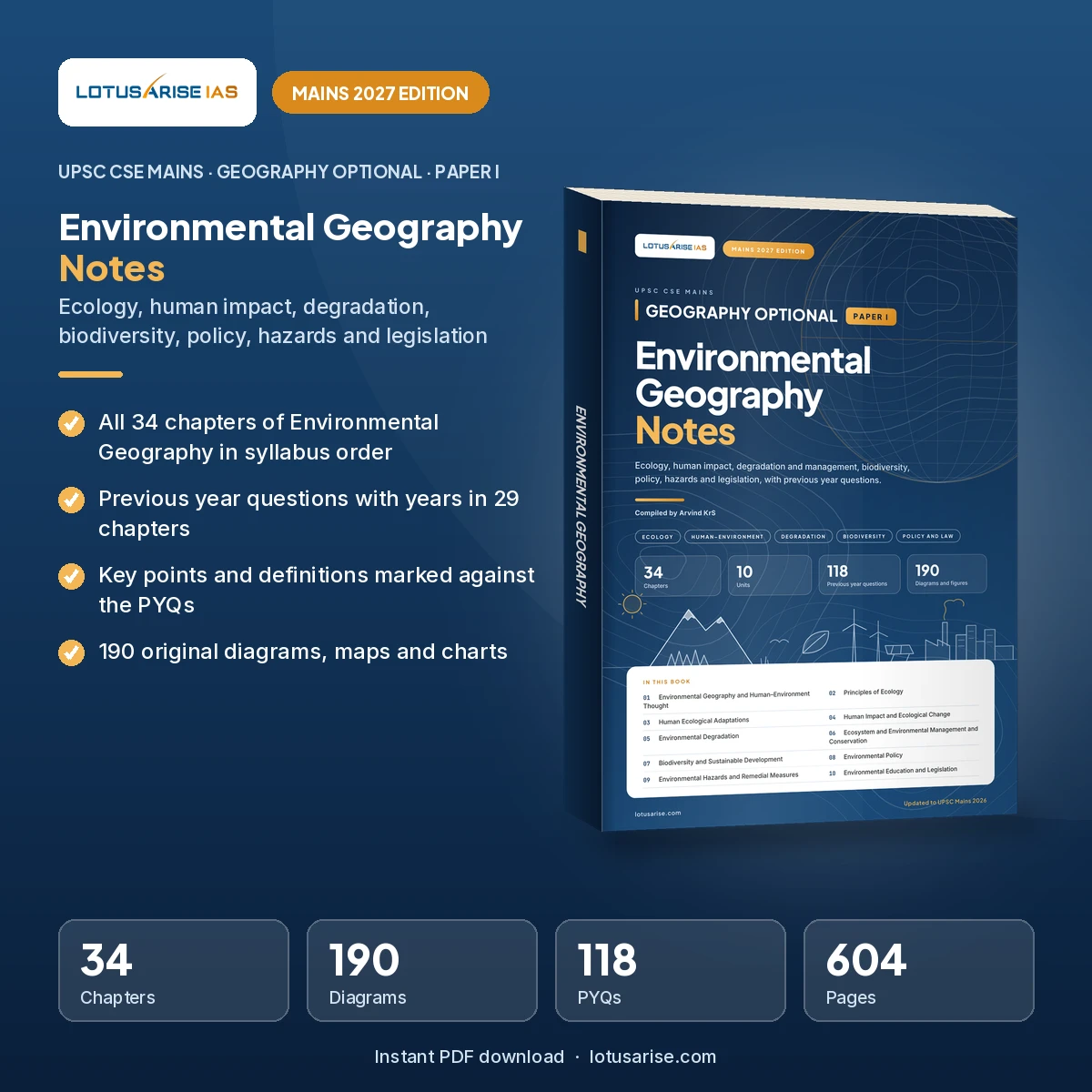
♻️ Environmental Geography — 635 pages, 34 chapters, 118 PYQs
Ecosystems and biogeochemical cycles, human ecological adaptations, large dams and mining, pollution, mountain ecosystems, EIA and SIA, PAVE theory, biodiversity, net zero, hazards and environmental legislation.
Free samples Geomorphology · Climatology · Oceanography · Biogeography · Environmental Geography
What makes this different from a downloaded PDF? Each chapter is marked against the questions UPSC has actually asked on it. A PYQ radar at the start shows how many times the topic has come and when it last did. Year tags sit on the headings UPSC has asked about. Faint highlights pick out key points, definitions and PYQ terms, and a PYQ list closes the chapter. Where UPSC has not asked directly, the chapter says so.
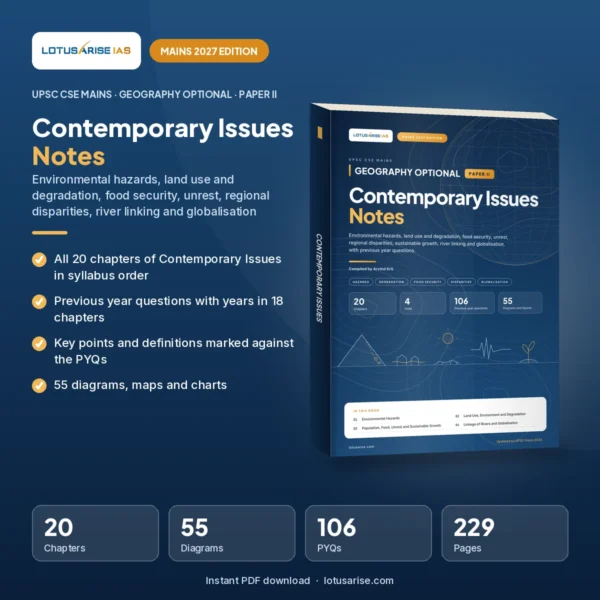
Where events move, the books give the date: NOAA’s October 2026 El Niño outlook and the deep-sea mining permit process in Oceanography, the COP17 review at Yerevan in Biogeography, and 103 Ramsar sites as of October 2026 in Environmental Geography.
PYQ counts are given book by book and should not be added, because one question can sit in two books.
One thing to be clear about: the bundle gives the previous year questions, not model answers. Solved answers are in the Geography Optional 300+ Score Pack.
The aspirant who buys this
First-timers You want one trusted account of Physical Geography from the start instead of collecting it branch by branch. Five books, one format, and you can read them in any order.
Repeaters You know Davis and Köppen, but your answers stop at the description. Go through the PYQ list at the end of each chapter, then read the tagged headings for what your answer left out.
Aspirants short of time before Mains 2,392 pages is a lot, so do not read them flat. The contents page shows the PYQ count for every chapter, and the radar, year tags and highlights show you what to read first.
Self-study aspirants outside Delhi, Prayagraj and Jaipur No classroom and no batch. You get five organised books that you can read anywhere, and print for handwritten practice.
Working professionals One chapter at a time on your phone, offline, with no schedule and no expiry.
State PSC aspirants with Geography Landforms, climate and soils are common ground, so the same chapters serve your paper too.
Why not just use free notes from Telegram?
Free notes exist, and most aspirants already have several. Many of these topics are also on our own website, free to read.
The difference is not that free material is wrong. It is that nothing ties it together. A forwarded PDF rarely tells you which of its pages UPSC has asked about, it seldom dates its figures, and nobody tells you when it has gone out of date. Here you get one format across five branches, every PYQ placed under its chapter, and files you can keep and print.
If you have the time to build and maintain your own file from scattered sources, you may not need this. If you would rather open one set and start revising, this is what it is for.
The price
5 books, 2,392 pages, 161 chapters and 808 diagrams and figures — ₹413. That is about 17 paise a page.
Bought singly at ₹118 each, the five books cost ₹590. The bundle is ₹413.
If you want Paper II as well, Geography Optional Complete Notes has all 20 books at ₹1,180.
One-time payment. No subscription. No recurring charge.
Each book is a separate PDF download, listed on your order. The download links reach your email right after payment — please check your spam folder if you do not see them. Unlimited downloads, no expiry. English medium.
Read the free sample first (PDF)
For support: support@lotusarise.com