Using the Autumn Fire Japanese Maple in Your Garden
Choose a focal position for your Autumn Fire Japanese Maple, and be sure to allow enough room for its spread – it needs space to show off all it has to offer. Perhaps standing out on a lawn, or in the corner of a simple urban courtyard. Plant it on a slope, perhaps among large boulders, or grow it in a large container. Perhaps it looks best seen from a window, or greeting you as you return home after a busy day. Spend some time choosing that spot – you will be glad you did.
Growing the Autumn Fire Japanese Maple
Size and Appearance
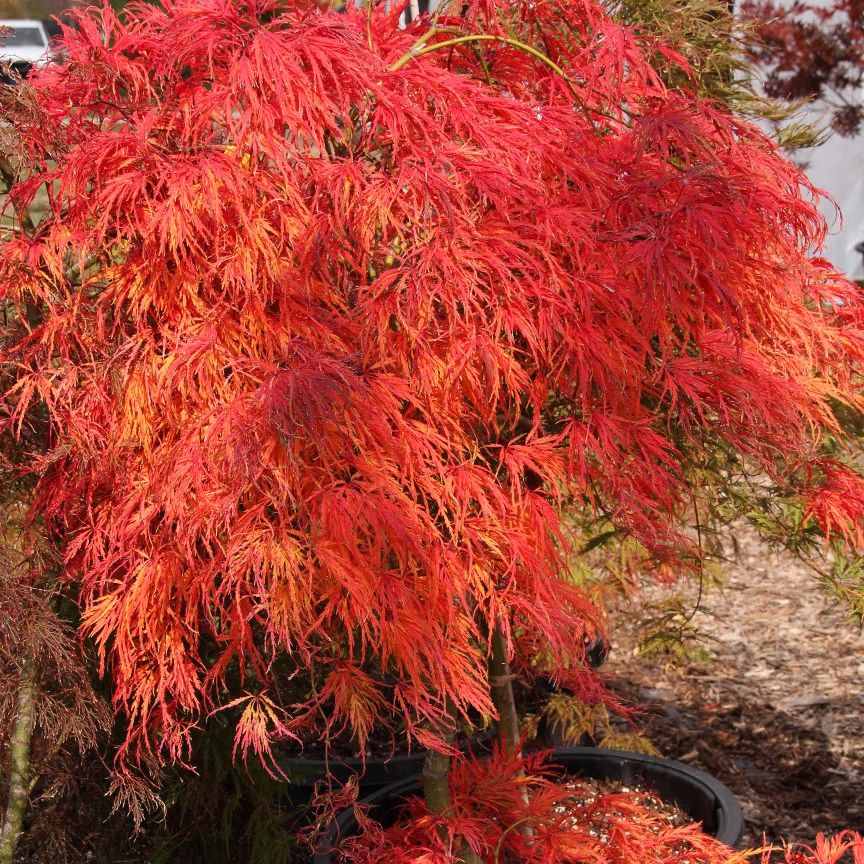
The Autumn Fire Japanese Maple is a small deciduous tree, with an elegant, graceful form. Young trees are often mounding at first, then about 5 feet tall and 6 feet wide, and mature at no more than 6 to 8 feet tall, but considerably wider, likely up to 12 feet across. Allow for this when planting, placing it at least 6 feet from walls, fences, and other potential obstructions. It has a form somewhere between weeping and horizontal, developing several trunks from low-down, which are often gracefully twisted. The smaller branches will be more upright when young, but soon develop into rounded, slightly pendulous shapes to show off the foliage. Young stems are green but become red as they mature over the summer months. Older branches and trunks have a smooth, light gray to soft brown bark. Growth is relatively fast for a dissectum variety, so you won’t be waiting forever to see it mature.
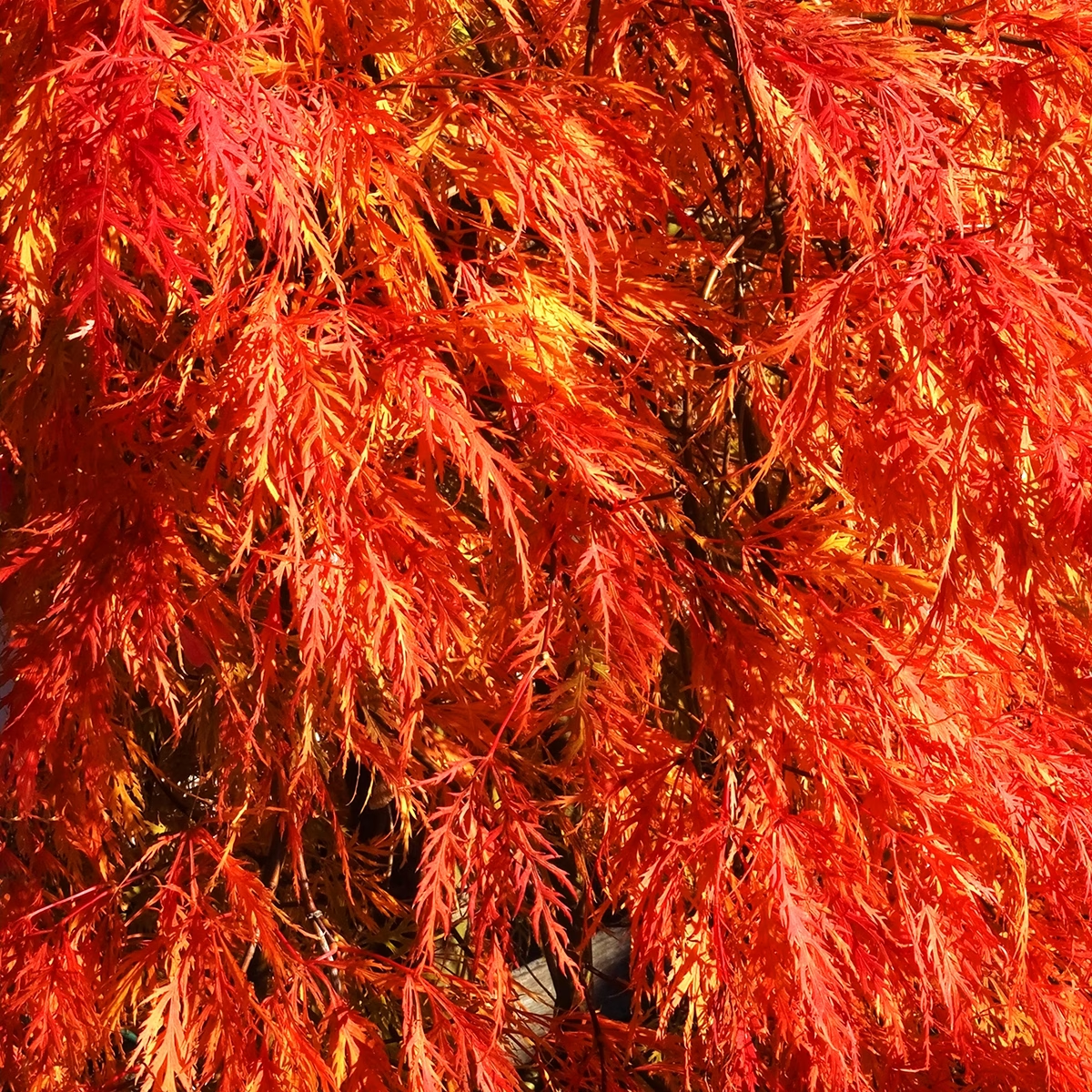
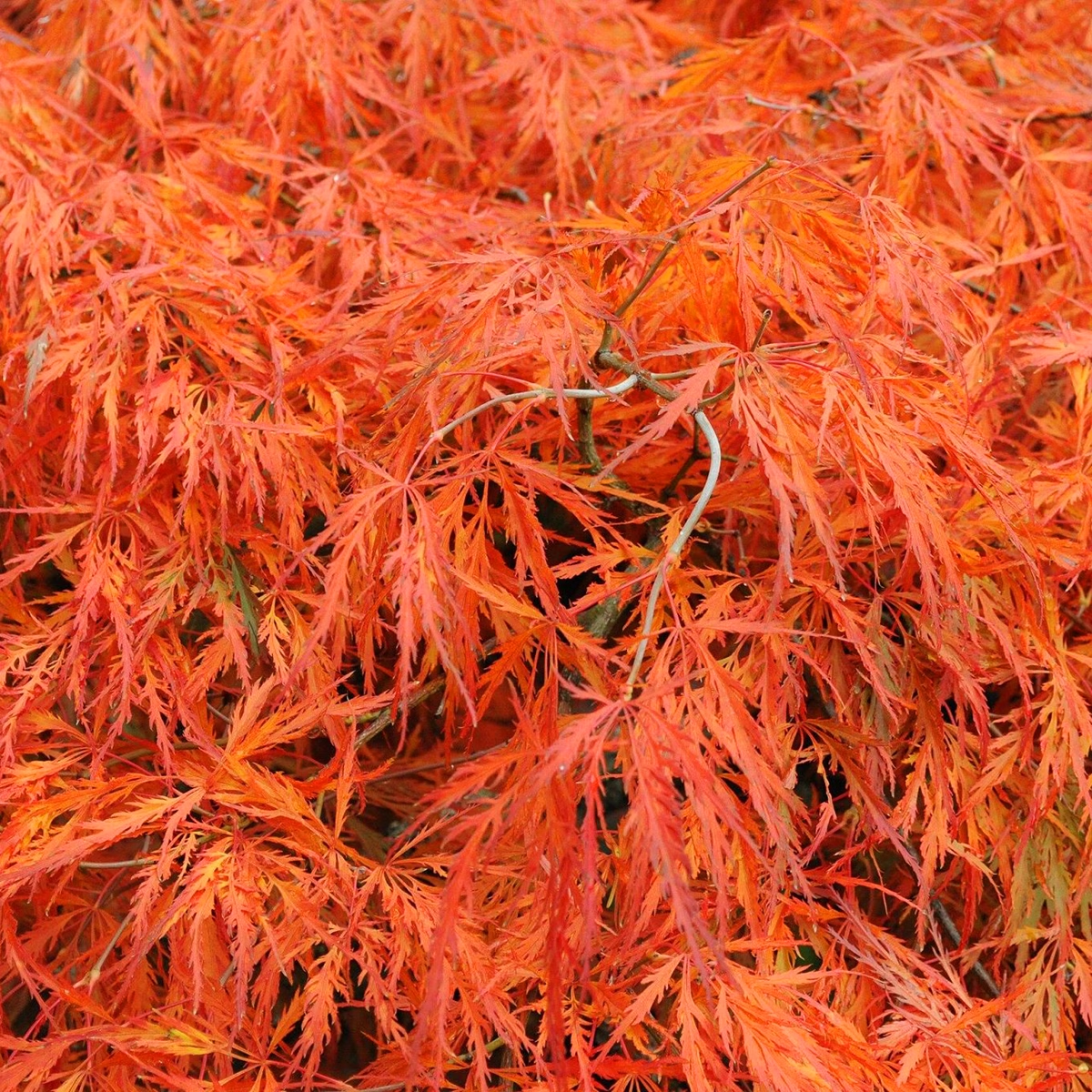
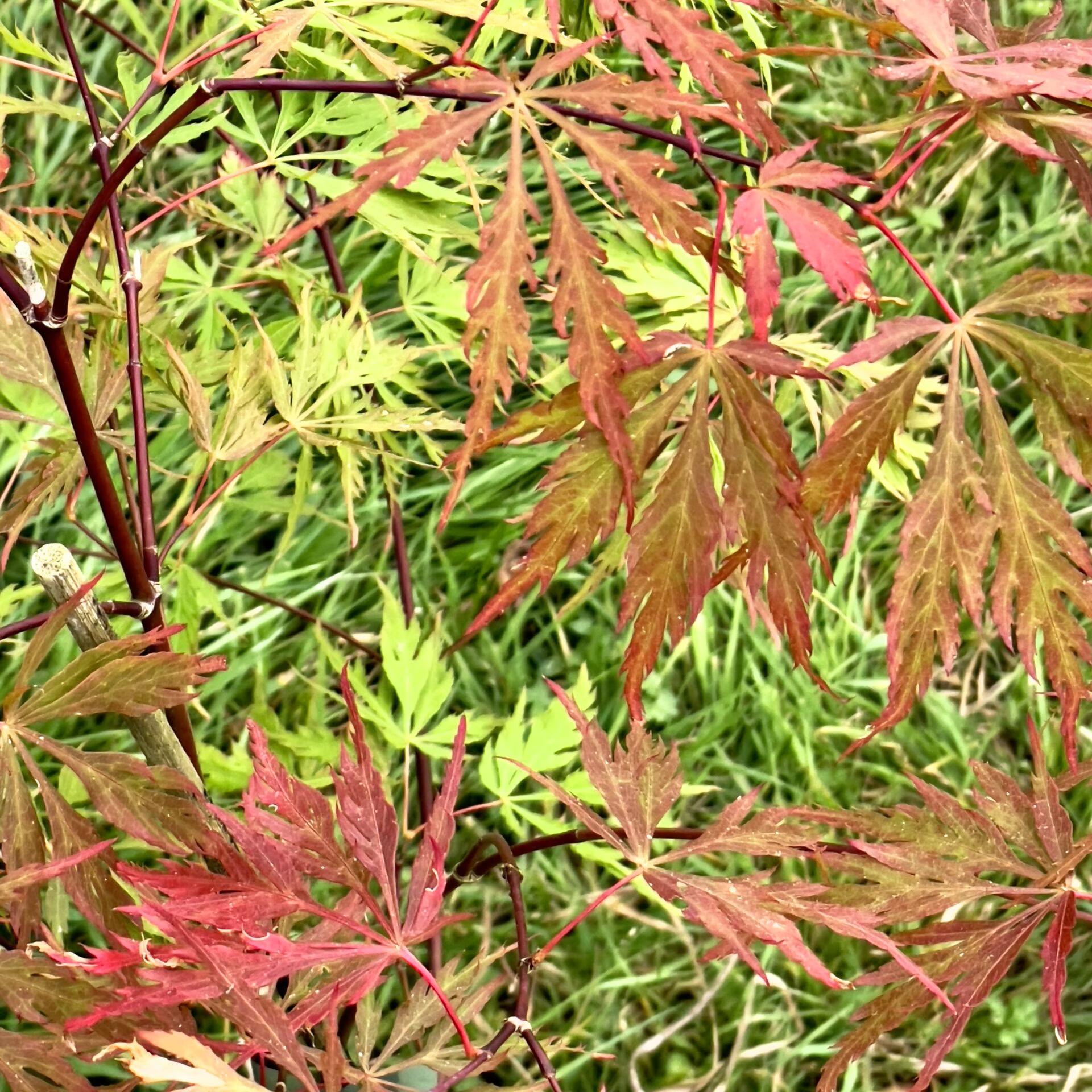
The foliage is of the perfect dissectum type, that is, each leaf is divided into 7 leaflets, occasionally 5 or 9. These radiate from a central point where the leaf meets the leaf-stalk, with no appreciable undivided base. Each leaflet is slender and almost thread-like, but then spreads out in several narrow fingers, creating a very charming effect. The leaflets are shorter than is often seen in this type, making them less susceptible to scorching. Spring leaves emerge with drooping leaflets, soft green edged in pink, before opening out like spreading fingers, and turning a warm green for the summer. As nights cool in fall they become suffused with brilliant tones of bright reds and oranges, creating a stunning, vibrant display that is among the boldest and brightest of any Japanese maple variety. Some red ‘keys’ (the seeds) may be seen on older trees, but these are not a feature of this variety.
Hardiness
Quite hardy throughout zone 5, the Autumn Fire Japanese Maple grows well right into zone 9, needing only a minimal amount of winter cold to thrive. It tolerates hot, humid conditions, and enjoys summer rain, but does less well in areas with hot, arid summers and little or no rain. If you are growing it in a pot in zones 5 and 6, bury the pot in the garden for the coldest months, digging it up again in spring.
Sun Exposure and Soil Conditions
This tree is relatively sun-tolerant, especially for a dissectum variety, and can be grown in full sun. Indeed, plenty of sun is best to enjoy the strongest fall coloring. It will also enjoy some afternoon shade in hot zones, and could also be grown in the light, scattered shade beneath deciduous trees. The ideal soil is moist but well-drained, slightly acidic, and rich in compost and organic materials. Dig the planting area well, incorporating plenty of compost, and use more as mulch. Young trees, in their first couple of summers with you, need careful monitoring for water, soaking it deeply close to the trunk as needed. After that it will be much more reliable and tolerate some dryness in summer, but remember this is not a drought-tolerant tree.
Maintenance and Pruning
Finding the right location, and providing good soil conditions is the secret to success with your Autumn Fire Japanese Maple. Given that, pests or diseases are almost never an issue, and in fact this tree is not difficult to grow. When grown in a pot, water when the top inch is dry, and use liquid evergreen fertilizer through spring and early summer. Some sensitive pruning, perhaps best done in early summer, will help you develop a mature look on your tree, and a graceful form. Removing twiggy growth inside the crown is a good way to proceed, and be inspired by picture of mature maples in Japanese gardens, and of bonsai trees.
History and Origin of the Autumn Fire Japanese Maple
The Japanese maple, Acer palmatum, is widespread in Japan, on almost all the islands, usually found growing in forests beneath larger trees, such as the giant cedars that fill the forests and provide lumber for temples and homes. Keen gardeners for centuries, the Japanese have collected unique forms of this tree for centuries, and all the earliest trees seen in the West were Japanese varieties. Since WWII American nurseries have been the source of many new ones, and it was Dells Japanese Maple Nursery in Junction City, Oregon who found the tree called ‘Autumn Fire’ in 1979. Once they saw how good it was they released it in 1996
Buying the Autumn Fire Japanese Maple at the Tree Center
Grown for you the correct way, by grafting a small stem onto a seedling tree, your Autumn Fire Japanese Maple is the result of several years of careful, skilled growing by experts in these trees. Don’t be taken in by cheap seedlings – they won’t be named varieties and can’t begin to approach the beauty of the best – like this one. A stunning feature for your fall garden, order now – we don’t have many trees available.