About this product
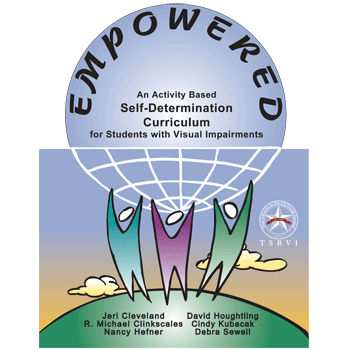
At the heart of everything we want to teach our students lies a set of skills that helps them become successful members of our communities. Self-determination instruction is part of this set of skills, and is based on the premise that students must acquire specific knowledge and skills and have many opportunities to practice them. Self-determination involves knowledge of self and others, decision-making, problem solving, goal setting, personal advocacy, self-control and knowledge of how to interact with the environment to achieve desired outcomes. The emergence of self-determination as a concept all its own allows us to target the specific skills that must be taught.
Since students with visual impairments must often be explicitly taught skills before they can use them spontaneously, the ‘Empowered’ curriculum, comprised of an Introduction and 23 Units, has been developed to guide the instruction of Self-determination skills. Authors: Jeri Cleveland, R. Michael Clinkscales, Nancy Hefner, David Houghtling, Cindy Kubacak, and Debra Sewell. Copyright 2007 Texas School for the Blind and Visually Impaired.
There is also a digital version of this publication available for purchase.
By Jeri Cleveland, R. Michael Clinkscales, Nancy Hefner, David Houghtling, Cindy Kubacak, Debra Sewell
© TSBVI 2007, 444 pp
Show allShow less
At the heart of everything we want to teach our students lies a set of skillsthat helps them become successful members of our communities. Self-determinationinstruction is part of this set of skills, and is based on the premise thatstudents must acquire specific knowledge and skills and have many opportunitiesto practice them. Self-determination involves knowledge of self and others,decision-making, problem solving, goal setting, personal advocacy, self-controland knowledge of how to interact with the environment to achieve desired outcomes.
The emergence of self-determination as a concept all its own allows us totarget the specific skills that must be taught. Since students with visualimpairments must often be explicitly taught skills before they can use themspontaneously, the Empowered curriculum, comprised of an Introductionand 23 Units, has been developed to guide the instruction of Self-determinationskills. Also included is a disc that can used for making large print or embossedcopies of the student activities.
Table of Contents
- Forewords
- Getting Started
- Unit Objectives
- Introduction/Orientation
- General Teacher Information
- Introduction to Students
- Objectives
- Key Words
- Materials
- Activities
- Teacher Resources
- Unit 1: Getting to Know Each Other
- Unit 2: Self-Awareness
- Unit 3: Identifying Strengths and Challenges
- Unit 4: Self-Acceptance, Coping and Compensatory Strategies
- Unit 5: Self-Management: Stress Management
- Unit 6: Self-Management: Self-Assessment Process
- Unit 7: Personal Control
- Unit 8: Communication: Basics of Communication and Active Listening
- Unit 9: Passive, Aggressive, Passive/Aggressive and Assertive Communication
- Unit 10: Personal Advocacy
- Unit 11: Decision Making
- Unit 12: Personal Values, Shared Values, Respecting Others’ Values
- Unit 13: Dreaming About the Future
- Unit 14: Setting Long-Term Goals
- Unit 15: Setting Short-Term Objectives
- Unit 16: Making Action Plans (steps to reach short-term objectives)
- Unit 17: Problem Solving Basics
- Unit 18: Problem Solving II: Goal Assessment and Revision
- Unit 19: Conflict Resolution/Negotiation
- Unit 20: Rights and Responsibilities (including legal status)
- Unit 21: Knowledge of Resources
- Unit 22: Advocacy Within Systems
- Unit 23: Where the Rubber Meets the Road
- Appendices
- Materials Chart
- CD Materials Guide
- Self-Determination Evaluation
- References
In Tsbvi's own words. See it at Tsbvi