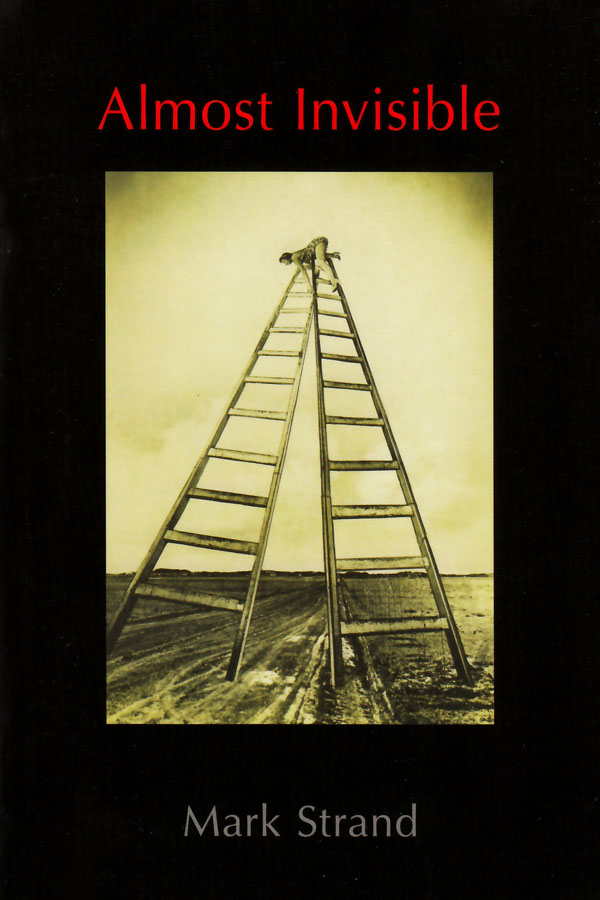
Reviews of Almost Invisible
The Warwick Review, March 2014
"The renowned American poet Mark Strand’s thirteenth book of poetry consists, in his words, of ‘prose pieces’. With prose poetry so well established in the US, it is surprising and highly unusual for a poet to define his work thus. Regardless of [his] choice of term, the pieces in Almost Invisible operate as prose poems, inhabiting a single mood or idea. Each consists of a single paragraph of one (albeit a very long one) to nine sentences.The qualities of Strand’s lined verse permeate the collection – meditative, witty and metaphysical … Strand’s style … appears simple without being plain, the language exact without calling attention to itself through distinctive choices … Almost Invisible creates a border state akin to one some of its poems directly address, through its intelligent investigation of people’s mental lives. Like the title characters’ progress in ‘The Students of the Ineffable,’ the passage through the book briefly obliterates the external, everyday world. As one such student remarks, ‘[O]ur work is important and concerns the self.’ ‘"But all your dust is darkening the stars,"’ the speaker replies, and the poem ends: ‘"Nay, nay," he said, "we are only passing through, the stars will return."’ One by one, Strand’s [prose] poems richly evoke without naming the ineffable: important work indeed."
Booklist
"Strand, a major poet of elegantly meditative inquiries, presents a collection of ethereal prose poems that read like koans and parables. People dissemble. Time is unruly. Inexplicable moments occur beside the ‘wrinkling, sorrowing sea.’ Landscapes are bleak, wind-scoured, disorienting. ‘The gates to nowhere multiply and the present is so far away, so deeply far away.’ Nothing is as it seems. Language is all we have to go on, and language is both path and shadow, rope and smoke. Strand’s titles suggest his by turns melancholy and ironic metaphysics: ‘Clarities of the Nonexistent,’ ‘The Enigma of the Infinitesimal,’ ‘Provisional Eternity.’ The rueful poet of lonesomeness, nothingness, travels without arrivals, Strand is also sharply funny, foxily ribald, and teasingly surreal. There is beauty here, albeit fleeting and steeped in yearning, ‘like fireflies in the perfumed heat of a summer night.’ And within these compact paragraphs, these brief, mysterious dream stories, the breathtaking cadence and resonant harmonics of words so precisely chosen and placed form exquisite, enrapturing, provoking,and shivery poems to be read and reread, lingered and marveled over.“ – Donna Seaman
Boston Review
“T. S. Eliot famously proposed that a poem is no less than a ‘raid on the inarticulate,’ an effort to make what has not yet been said pass into speech. But Strand’s objective is somewhat different, even counter to that. He aims to engage with the inarticulate, to approach it, moving outside of the visible in order, ideally, to inhabit that unknown space. He suggests that the work of the poem could be to bear witness to that which cannot be articulated, even as it calls to us … Strand is probing one of the limits of poetry, and of language in general: the impossibility of silence. Every imagining of absence is constructed in presence, and the poem, like our mortal efforts to see beyond our own finitude, shackled by its own material existence. Strand’s poems are built on this tension, and their glacial calm belies a fury in the ‘almost’ of the book’s title.” – Jay Deshpande
Publishers Weekly
“Strand’s 13th collection comprises a series of short prose poems that borrow elements of fables as well as more modern forms of fiction, all with the grim turns and deadpan beauty for which Strand, who won the Pulitzer and is among the most famous American poets, is known. In one poem a man returns ‘to the country from which he had started many years before’ to find, in his childhood playground, ‘dust-filled shafts of sunlight struck the tawny leaves of trees and withered hedges. Empty bags littered the grass.’ Another waxes nostalgic about nostalgia itself, ‘those hours given over to basking in the glow of an imagined future, of being carried away in streams of promise by a love or a passion so strong that one felt altered forever and convinced that the smallest particle of the surrounding world was charged with a purpose of impossible grandeur.’ A poem called ‘In the Afterlife’asks, ‘When no one remembers, what is there?’ These are poems of failing light, meditations on death’s nearness that do nothing to stave it off. This is a short book, but Strand’s many fans won’t be disappointed.
Poetry Northwest
“When pressed to make a choice … as to which 2012 collection could be called my absolute favorite, I landed firmly on a book of poems not even considered a book of poems by its author: Almost Invisible. Mark Strand’s most recent collection of short prose pieces (as he calls them) has all the trappings of his previous attire – the infamously repetitive diction, the drippy nostalgia, and, of course, that hallmark debonair fatalism. But these poems are far from being placid guff. The poems of Almost Invisible are nimble and tonally varied, smart and introspective – the epitome of Strand’s best late-period work. Longtime readers of Strand will especially enjoy Almost Invisible for the way it humorously converses with past poems, such as in “The Mysterious Arrival of an Unusual Letter,” which seems to talk back to both “The Mailman,” a poem from Reasons for Moving, and “Elegy for My Father,” which appears in The Story of Our Lives. They’ll also enjoy the way these poems continue to build on the frivolity and dark comedy that has been present in his work since Dark Harbor. New readers will respond, just as they always have, to Strand’s impeccable timing, the paradoxical, and the haunting manner in which the poems enact “slowly things (slipping) away.” If you missed this book, then run, don’t walk. This is a chance to experience a poet at his most flexible and, oftentimes, his most moving. – Justin Boening
Ever So Many Hundred Years Hence
Down the milky corridors of fog, starless scenery, the rubble of ocean’s breath, that lone figure strolling, gathering about him without shame a small flood of damages, concessions to a frailty which was his long before he knew what he must do or what he must be, and now, with his hand outstretched as if to greet the future, he comes close and pours out to me the subtlety of his meaning and I see him, my long-lost uncle, great and golden in the sudden sunlight, who predicted that he would reach over the years and be with me and that I would be waiting.
The Waywiser Press
The Mysterious Arrival of an Unusual Letter
It had been a long day at work and a long ride back to the small apartment where I lived. When I got there I flicked on the light and saw on the table an envelope with my name on it. Where was the clock? Where was the calendar? The handwriting was my father’s, but he had been dead for forty years. As one might, I began to think that maybe, just maybe, he was alive, living a secret life somewhere nearby. How else to explain the envelope? To steady myself, I sat down, opened it, and pulled out the letter. "Dear Son" was the way it began. "Dear Son" and then nothing.