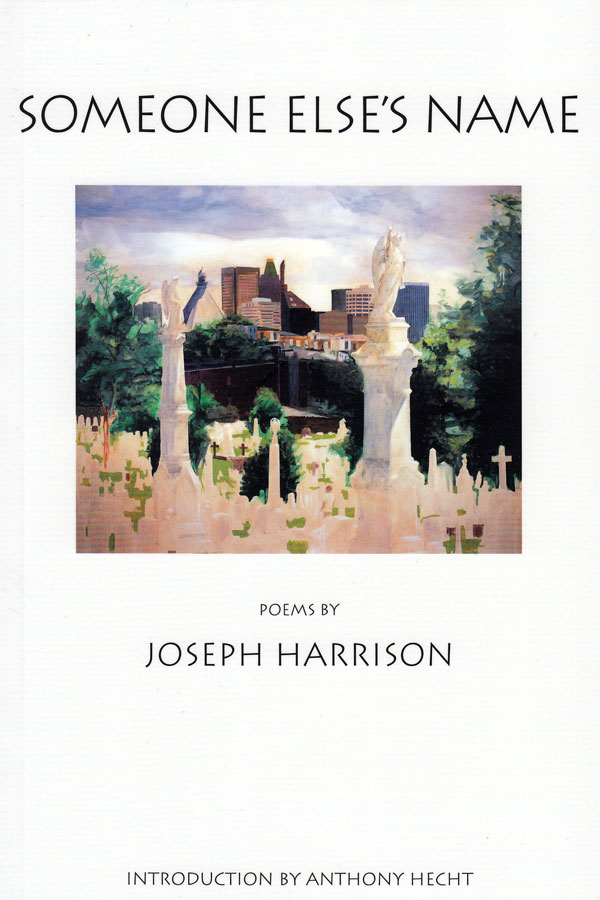
… I want to single out two major poems for comment, eminent amidst their excellent companions. Of these, ‘View of Baltimore from Green Mount Cemetery’ strikes me as an achievement that belongs with the great elegies in the language, utterly unembarrassed in the company of Gray, and, indeed, serving as an urban, sophisticated and modern counterpart to that poet’s rural and simplistic view of life and society. This poem is a triumph in its breadth and depth of vision, its huge compassion, its irony, civility, and quiet refusal to adopt grand, funerary postures. There is a surer grasp of the modern world in this poem than can be found in most poetry or fiction. The other, no less ambitious, is ‘Mobile Bay Jubilee,’ in which a ground (or sea) bass from Spenser serves to contribute to a music wholly Mr. Harrison’s own, a glorious mix of headlong improvisation and formal orthodoxy, like the best New Orleans Jazz (though the setting is Alabaman, where even tall tales are true), in which the bounty of the sea annually gives itself up in a sort of piscine miracle, like the fertility of the mind, (‘that ocean where each kind / Does straight its own resemblance find …’) or like the one Ben Jonson describes in ‘To Penshurst.’
… The jubilation of ‘Mobile Bay Jubilee’ balances the solemnity or the occasional note of gloom to be found elsewhere. And these two major poems serve to exhibit, in their polar pivots of grief and gaiety, the impressive extent of Mr. Harrison’s vocal range. As Frost said, after the immedicable woes comes play. Mr. Harrison’s technique never fails him, his capacity for conveying the deepest and most subtle feelings is sure and accurate. Best of all, in every poem here, irrespective of mood or weight, the reader will encounter the sheer joy of a poet gladdened by his own art, alive to the liberties and limits of form and imagination – playful, serious, gifted, multi-vocal and athletically adroit."– Anthony Hecht (from the Introduction)
"Sad and funny by turns and often simultaneously, the quests, meditations, and laments in this rich collection are unfailingly sane – no, more than sane, wise. Furthermore, Harrison’s every poem is lullingly melodic, though each sings a different tune. This exceptional debut is a rare delight." – Rachel Hadas
"Someone Else’s Name is a first book full of stunning performances, each one infused with wit, feeling, and humanity, and each one delighting in the full use of the medium and its devices. It’s a happy thing to witness the emergence of such a talent." – Richard Wilbur
"In this brilliant first book the deepest of feeling and the most profound thought rise up in response to a glittering surface of wit, which is never an end in itself. Throughout these poems, deep poetic learning and passionate responses to immediate experience interanimate one another. Mr. Harrison’s imagination is unflagging, and can keep going through ‘As If’, a splendid revisionary sonnet sequence, or the remarkable ‘Mobile Bay Jubilee’. His is an outstanding talent, and he does not betray it by anything but the most meticulous of workmanship." – John Hollander
" Someone Else’s Name is a book of brilliant wit, erudition, and technical ingenuity, and, played for the highest stakes, is no less than a quest for personal and artistic identity through poem after poem in which no reader can fail ‘Underneath their curlicue and flair / [to] hear the real pathos there.’ It is a stunning book." – Greg Williamson
"Seven years ago the poet Greg Williamson sent me a slim manuscript by his close friend and Johns Hopkins colleague, Joe Harrison. I was very impressed by what I read, but it just didn’t prepare me for the impact of this stunning and ample first collection. Harrison has all of Williamson’s strengths. He is a punctilious metrist, a born rhymer, an inventor of graceful, intricate stanzas. He’s also ingeniously contemporary, as in the two poems for Dante the robot, which was lowered into the caldera of Mount Erebus. In flawless terza rima, of course. Or the little ode "Air Larry," about the nut case who rode his helium-balloon-powered lawn chair into the jet space 16,000 feet above L.A. Yet everything he writes is invested with a deep learning, worn lightly, borne of wide reading in the canon. He is a far more mournful poet than his younger friend, and his concerns are more elemental, less cerebral. If I have any reservation about either of them, it is that they are too much concerned with the themes of iteration, with writing poetry on poetry. But that’s the reaction of a farmer to most academics. In his fifth decade, Harrison is a fully formed, dazzlingly fine poet; and every lover of our ancient art will be grateful to have this book on his shelf." Amazon and BN.com ranking, five stars." – Timothy Murphy
Book of the Year Nominations
Washington Post, December 2004
Edward Hirsch
"The poems in this first book are so witty and formally adept, so technically accomplished, that they almost seem to come from another era."
Reviews of Someone Else’s Name
New York Times, August 15th 2004
"For many poets, inherited rhyming forms are themselves an attractive artificial setting, a literary-historical Elysium where pure technique finds its rewards. Joseph Harrison’s Someone Else’s Name makes him the latest to master this realm. Like John Hollander, Harrison devises art about art about art, ‘reflecting back the world / While reflecting on reflecting back the world.’ Humor and personality emerge organically from the intellectualism and the loneliness that led Harrison to his complex art. ‘As If,’ a sequence of love sonnets, starts with abstract, very literary, pining. Then the lovers get together at last, ‘And suddenly we’ve made a living thing. / I freak. I quail. I crow. I buy a ring.’
Harrison’s most serious poems, with their cold, depopulated locales, pick up on the grimmest bits of Robert Frost: in ‘The End of Dewitt Finley’ a snowbound salesman starves to death in his truck. After such harsh forests of symbols, it’s a joy to find ‘Mobile Bay Jubilee,’ an expansive homage in giant acrobatic stanzas (borrowed from Edmund Spenser) to an annual tidal event ‘when the fish come forth from the sea / And the sweet flesh of the deep can be had for a song.’ Scholars might call it a piscatory ode; Alabamians might call it a feast." – Stephen Burt
London Magazine, April-May, 2004
" … the tone of Joseph Harrison’s collection is teasingly sophisticated and technically clever. Its presiding genius is really Shakespeare, a mentor Harrison seems almost to challenge in a sequence of twenty-two linked sonnets on the subject of love – its frustrations, its brief fulfilment, its inevitable betrayal. In his post-modern way, Harrison all but outbids Shakespeare; we are encouraged to accept Harrison’s lady as his own invention. Real or imaginary, the beloved’s true status hardly matters, since the title of the sequence, ‘As If’, tells us right away that it’s art we are engaging with, not life.
Let me begin, as if there never were
Whole sequences of pyrotechnic verse
Flashing the features of some him or her,
Implying all the meanwhile, what is worse,
That all is just projection, that the fame
Offered the bright beloved, age by age,
Laura or Stella or some other name,
Sparkles and dazzles only on the page.
O let me start, as if the mind were free
Of all those pretty rooms and polished turns
That flip their figures so predictably
We know what freezes will become what burns,
As if these lines could stammer something true
To someone real, as if there were a you.
Well, I could go on quoting for twenty-one more sonnets, each as smartly kitted out as that one. If Harrison were no more than a clever aesthete there might be some point in protesting against such frivolity. He pleads his own cause beautifully, however, in the delightful couplets of his opening poem, ‘All That’s Left’ … [which] show that, dandy though he is, Joseph Harrison has a keen sense of the loneliness of the long-distance artist. There’s a good deal going on under his fancy dress." – Anne Stevenson
Acumen, September 2003
"The corona of sonnets is with us again in Someone Else’s Name by Joseph Harrison … This time it comes in the form of ‘As If’, a sequence of 22 virtuosic sonnets, in which Harrison plays serious (and not so serious) games with the whole tradition of the love sonnet. Harrison’s use of the form is a good deal freer than Bridgford’s (the observation is offered as description, not as evaluation) and there is a joyous wit in the way he effects the links between the last line of one sonnet and the first line of its successor. A couple of examples. The closing lines of sonnet 15:
Then failure be my triumph! Year by year
I’ve artfully pursued the non-career
From the beginning, down to these very words.
And the opening of sonnet 16:
These very words, like bells, will take their toll.
Let’s at the least, Petrarchan rigmarole
Aside, admit that that’s the case.
The same sonnet 16 closes thus:
…………………………………I tire
Of such exertion, come up short of breath,
No longer young, and straining to expire
At times when every line’s a little death.
and Sonnet 17 begins as follows:
A little death goes a long way, it’s true.
Bare boughs, bare choirs, a dangling leaf or two
Wordplay and allusion are Harrison’s stock-in-trade and he is a master of both (the love which is the subject of ‘As If’ is described there as pursuing "a course sidereally crossed"). There is a constant fire-work display of half quotation and pun – too much so, no doubt, for some tastes. For the most part I found it exhilarating; Harrison’s sheer facility is itself exciting and only occasionally does it seem to get the better of him and lead him into excess. At his best he is a master of the counterpoint between the demands of, on the one hand, syntactical structure and, on the other, those of metre and stanza form. Watching him find ways to meet both demands is one of the pleasures of reading this collection. Harrison’s use of the traditional forms he adopts I adapts is never merely slavish. So. when he writes rhyming couplets he effectively syncopates the rhyming:
Will someone tell me, please,
Who carved these trees
With someone else’s name?
These woods won’t be the same,
For I thought, all along.
Mine was the only signature among
These pale textures of bark
Rising out of the dark
Underworld of the forest floor.
But who was here before?
Traditional genres are ‘updated’ too. ‘As If’ redesigns the Petrarchan sonnet sequence, and in ‘View of Baltimore from Green Mount Cemetery’ the traditions of Graveyard poetry are recomposed (though not quite as radically as they were by the English Harrison in ‘V’). Joseph Harrison’s is a distinctive voice which is never less than highly entertaining; this is a mind of great quickness and wit, served by a sheer skill that is itself a pleasure to encounter. " – Glyn Pursglove
Rattapallax, Summer 2003
"Joseph Harrison’s first collection, Someone Else’s Name, carries a glowing blurb from Richard Wilbur (complimentary almost to the point of giddiness), and a lengthy, glorifying introduction by Anthony Hecht which, taken together, may be the closest thing to a money-back guarantee a publisher can offer …[The book] is … a Major Accomplishment …And, more importantly, it is enormous fun." – Jon Mooallem
The Hudson Review, Spring 2004
"… in an effusive introduction to Harrison’s first collection … [Anthony Hecht compares the poet] to none other than John Donne. While this may be a bit overmuch, one can well understand Hecht’s enthusiasm for Harrison, who, as he observes, obviously ‘not only loves his art, but delights in it.’ Harrison has formidable technical skills yet wears them lightly: ‘everywhere,’ as Hecht puts it, ‘the poet is both at liberty and in control.’" – Bruce Bawer
All That’s Left
For I thought, all along,
Who chiseled each new line
On everything I thought was mine,
Initialling all these
Purely imaginary trees
Deep in the forest of my mind?
No Orlando, mad for Rosalind:
These cuttings, even when crude,
Speak only out of solitude,
The signs of a single heart
That gave its love to art
And wore that on its sleeve,
Having come to believe
It was the necessary sacrifice,
And paid the price.
If someone else could see
These careful lines, would he,
Underneath their curlicue and flair,
Hear the real pathos there,
The note of the ultimate cost
When feeling itself is lost
And all that’s left is the mark
Of absence against the dark?
The Waywiser Press
Song
Like the first cold trickles to slip
Between blue shingles of shale
High on a famous mountainside,
To run and pool and spill
And, “echoing down the vale,”
Spread far and wide,
Like the first gray gull to appear
As the light fades, and sail
Past the tall buildings, floating home
To the harbor’s storied repair,
Till, dot by dot, without fail,
The birds come,
Like the first tipped prong to unfold
A tentative hint of white
Against the green of the fabled tree
(Where once such fruit fell down!),
Which will, in days, ignite
Quite suddenly
Pale tier upon tier of apple blossom,
Loading its limbs and curling
Fingers, like and unlike the snow
That packed the tree with snow-bloom
During the freak storm swirling
Just days ago,
So the idea for the poem
Starts with a layered phrase,
A story, a simile, a sleight,
And though the poet may mope
Through the flat, vacant days,
Or cry at night
For the lightning he almost believes
Struck him once, long ago
(When mind was fire, and heart was song),
Something won’t leave him be,
But mumbles, liquid, slow,
And pulls him along
To where the desk juts like a cliff
Above the original sea,
And the white wings flash in the sun,
And a light comes on with a flick,
And clear, emphatic, free,
The words come.