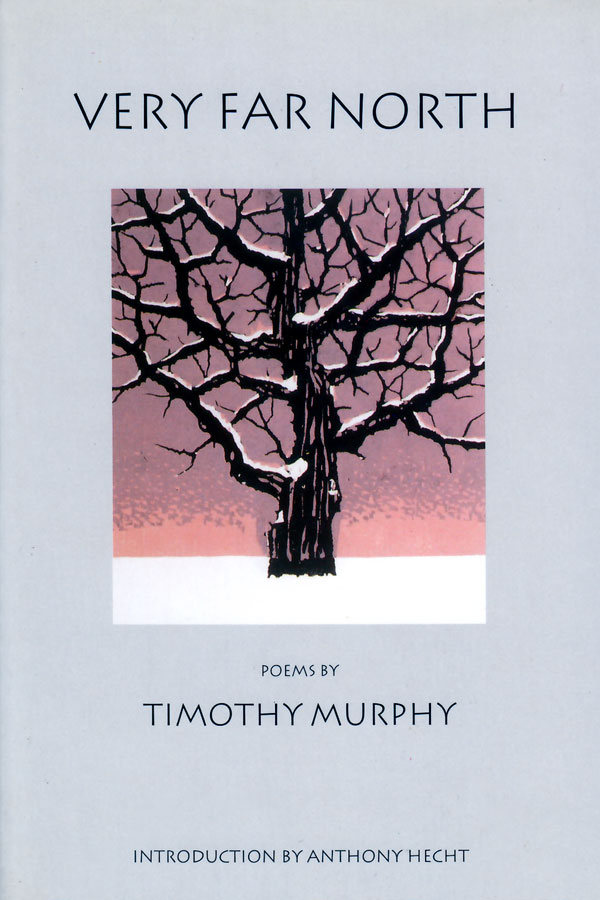
“When he published his first collection, The Deed of Gift, Timothy Murphy was already a mature and greatly accomplished poet; but in Very Far North he has gone from strength to strength.” – Richard Wilbur
Reviews of Very Far North
London Magazine, April-May 2004
"Timothy Murphy, who hails from North Dakota, is another farmer poet whose gift for epigram and appetite for mental voyaging calls to mind Emily Dickinson, though a line of Frost’s gave him his title, Very Far North. (‘It is very far north, we admit, to have brought the peach.’) Murphy is a clever, aphoristic poet whose short poems either work or they don’t. There is little middle ground. When he hits the nail on the head he’s as sharp as any of his mentors.
Dakota Greeting
Frosted sign in a frozen ditch:
Stranger, welcome to Oakes,
home to hundreds of friendly folks
and one mean son-of-a-bitch.
And here’s is another, rather more profound, called ‘The Abyss’.
His subterfuge is deep
and devious is his task,
but the man behind the mask
I take off when I sleep
is the one friend I can ask
to look before I leap.
Like Frost before him, Murphy is an interesting mixture of plain-speaking countryman and complex intellectual. After studying with Robert Penn Warren at Yale he took his teacher’s advice and returned to his Dakota roots. Ambition and restlessness have taken him further afield, and you’ll find in Very Far North surprising references to Norse mythology, Greek tragedy, Inuit and Sioux legends and Japanese art. Sometimes his references are personal, sometimes they are obscure, sometimes erotic, sometimes side-splittingly funny with gay overtones, but mostly, when he takes risks, Murphy wins. This poem called ‘Collateral’ is typical.
‘Go home, boy. Buy a farm.
Sink your toes in that rich soil
and grow yourself some roots.’
No stranger to the toil
of those who raise their fruits,
he clasped my freckled arm
and dragged me down to earth.
I learned to measure worth
as the plough measures a furrow.
Calling on country banks,
I pledge, encumber, borrow
and tell a dead man, ‘Thanks.’
Iambs and Trochees
The first fifth of Timothy Murphy’s "Very Far North," subtitled "No Place for Trees," surveys rural North Dakota, a land that has been losing population for a century. The people who hang on are like the trees in the poem from which the section takes its title: "A few scrub oaks survive / droughts, blizzards, and disease." Later, in "The Last Sodbusters," they are described directly, etched and scored by the land that they in turn have ploughed: "Care furrows the brow / and bows the straightest frame."
Unlike Murphy’s previous collection, "Set the Ploughshare Deep," this book has no illustrations or prose passages to contextualize the poems, nor does it need any. For all their meticulous craft, the poems here evoke the senses, the sights and sounds, smells and textures of a place that grudgingly, sporadically repays all that human ingenuity and perseverance can do and that just as often frustrates it. Here, for example, from "Unposted," we see a life’s work dwarfed by the sweep of time and geography:
Abandoned where the grass grew lank and damp,
the antiquated grain drill seemed a toy
some Lilliputian farmer might employ
to plant a field small as a postage stamp.
Elsewhere we hear the voices of people accustomed to expressing themselves succinctly, perhaps to save breath against the incessant wind. A "Master Farmer," maimed by his machinery, says, "The picker took my fingers / to fertilize this land." On a Sunday morning "while country wives are praying," a "Godfearer" runs his plow across "the powdery plain" and offers his own supplication to heaven: "Now where’s the goddamn rain?" Not content with sweat, the land demands the farmer’s very flesh. No amount of effort can make up for the rain that doesn’t come on time and the wind that does, making the biblical "dust to dust" quite literal.
"Very Far North" takes its title from a line in Frost’s "There Are Roughly Zones," in which an orchard keeper acknowledges the folly of planting fruit trees at a high latitude but also admires, it seems, the very human refusal to let nature have its way unchallenged. Farming is both the most natural and the most artificial of our occupations: even as we depend upon the forces of nature we try to channel them into unnatural forms. In a harsh land like North Dakota, the effort fails as often as it succeeds.
In a sense that doesn’t involve nearly as much dirt and sweat, a formal poet does the same thing. Murphy shapes the natural cadences of speech into tight, formal verse, often trimeter lines with (usually) perfect rhymes that in the hands of a lesser poet would sound stilted. But like the successful farmer who makes the land yield far more than it would untended, Murphy turns colloquial talk into music. These are poems not only meant to be sung but almost impossible not to sing. Their music is as engrained as the lines in that sodbuster’s face.
The third part, "Elsewhere," broadens the scope. It portrays not merely a change in venue but a change of heart – or perhaps something unchanging in our deepest nature: the need always to be pressing onward, outward. "A fisherman longs for the land-locked farm / its tenant would trade for the sea," Murphy sings in the second of the two ballad stanzas of the title poem.
This upland bird hunter and abandoned farm stalker turns out to be an avid sailor. In many poems he trades the horizon-wide plains for an even wider sea where he is no less at the mercy of wind. Like farming, hunting, and hiking, though, sailing is another discipline that involves finding the art in nature and the nature in art – and not unlike poetry. Murphy’s verse can be the boustrophedon of a plowed field, and it can, equally, be the zigzag tack of a sailboat. Here, in its entirety, is "The Watch," a poem about sailing, love, and poetry:
When I leave this little ship
(which I can ill-afford)
springlined in a slip
I leave my love aboard.
If the weather is in doubt
he scans the sky for signs.
When the spring tide runs out
love will adjust my lines.
Those concluding lines, in particular, work in various distinct but complementary ways. The "spring tide" that "runs out" is quite literal but also suggests the onset of age that we all hope our love will outlast; the "lines," of course, are real ropes holding a real boat, but they are also lines of poetry and, perhaps, the bonds of affection, lines that contract and attenuate but, with luck, always hold.
Finally, in "Timing" Murphy writes about the aspiration that motivates a life well lived and a poem well written:
Walking a narrow path
where pilgrims go astray,
I regulate my breath
because I cannot pray.
By "pray" he must mean the rote, conventional prayers of his boyhood. These poems are all prayers, each original and each vital, sung in the regulated breath of a voice both disciplined and wayward. – Richard Wakefield
Boston Review
“Where are the heirs of Richard Wilbur? If you don’t care, skip the next two paragraphs; if, like me, you admire Wilbur’s meticulous poems but haven’t cared for most of his imitators, you’ll want to meet the North Dakota farmer Timothy Murphy, whose chiseled epigrams make him the most formal, and perhaps the most interesting, new ‘formalist’ in some time. The best poems in his second book of verse, Very Far North, all draw on his plains locale. ‘The Last Sodbusters’ remembers the first farmers to settle Montana … ‘Nature’ in North Dakota offers Murphy very few comforts and no illusions; the comforts appear at home, through labor of skill, signs of erotic and parental love … Such compact forms enunciate, as they reflect, an ethics: farming, like poetry, is no respecter of persons, and requires both smart planning and long labor for a product (grain, hogs, couplets, wisdom) whose end-users may never know how much work it took. A skilled Dakota farmer (like a Murphy poem) therefore wastes no syllable, no bit of dirt. Murphy can use other preindustrial crafts (hunting, sailing, animal husbandry) as subjects and analogues for similarly well-made poems … [H]is good poems are poems Frost, or Jonson, might have admired." – Stephen Burt
Acumen
“Though educated at Yale, Murphy’s roots (and present life) are in the agricultural world of North Dakota. Richard Wilbur provided a Preface to The Deed of Gift and this third collection carries an introduction by Anthony Hecht – good enough indication of the tradition to which Murphy belongs, although be is far from being merely derivative or imitative. Any serious attempt to define Murphy’s line of inheritance would, indeed, have to begin with the Greek Anthology and, in more recent times, include Walter Savage Landor and Hardy, Robert Frost and J. V. Cunningham. Like a number of these poets, Murphy is at his best in the short poem (and, often, the short line). He can be witty and grave, can achieve a chiselled quality that responds to his bleak environment and articulates an alert sense of transience and mortality. Here, for example, is ‘Dies Irae’:
At the field’s edge a feather
clings briefly to a bough
before a change of weather
offers it to the plough,
much as it did my father.
How wonderfully effective that comma is at the end of the fourth line! Sometimes Murphy achieves a kind of gnomic impersonality in lines which seem to belong – without affectation – to another age than our own, as in ‘Four Sorrows’:
Seed carelessly planted,
fair counsel rejected,
love taken for granted
and Sappho uncollected.
Another four line poem presents a wry self-assessment:
I am no man of letters,
only a puppet on a string
dancing jerkily in my fetters
when I hear my betters sing.
(‘Lines written in Bondage’)
The exactness of ear and the modesty are characteristic notes; in truth Murphy’s is an utterly distinctive voice, his world not one with which most of his readers (least of all in Britain) will be familiar. Strongly recommended.” – Glyn Pursglove
Minneapolis Star Tribune
“North Dakotan Timothy Murphy’s Very Far North … is the best in this crop [of six new volumes of poetry], and that’s very good indeed. Whether grave or humorous, Murphy’s high-plains voice is always eloquent and clear. He presents images and stories unique to North Dakota … [b]ut his allusions and melancholy wisdom testify to a broader, borderless view.
Murphy writes of harsh seasons, of a father’s death, of depression, love and lust. He writes about farmers, horses, boats, wild animals and other poets. In one poem the language is colloquial; the next one is rife with classical allusions. None of his many notes is predictable or false.” – Pamela Miller
Contemporary Poetry Review
“A traditional poet in every sense of the word, Murphy possesses a classical temperament which comprehends tragedy and human suffering; he knows that “Care furrows the brow / and bows the straightest frame. // Thistles follow the plow, / and hail threshes the grain.” Spare and unadorned as a Dakota prairie, Murphy’s poems are generally short in line and length, metrically tight and artfully rhymed. They can evoke the solemn tones of a biblical psalm or the lucid brilliance of a Greek lyric. His verbal landscapes and portraits depict the lives and character of his local culture and region, yet look beyond them to primal elements and patterns that predate human history:
Our Bronco bucked on rocks as daybreak’s glow
drove darkness down the range from summit snow.
We rode to where the switchback track was blocked;
and then we walked
into a world where strings were not yet strung
on tortoise shells, where Gilgamesh was young.
Haunted by rituals as old as human conscious-ness, Murphy’s poems mingle observations about farming, hiking, hunting, loving and dying with allusions to Greek, Native American, and Norse myths. In writing of farming or hunting, he celebrates ancient virtues like hard work, good husbandry, and expert marksmanship. Concluding his book with a group of poems on Chinese and Japanese history and art, he appears to have found – amidst North Dakota’s arid plains and buttes – the fabled Northwest Passage to the East.” – Paul Lake. To read the full review, please click here: Full Review of Very Far North
Light
“The astute reader may wonder why Light should allow me space to review a collection of poems of which about three-quarters are serious. The reason is that other quarter. Two dozen of these poems are unmistakably light in tone, though some are sharp-edged, bittersweet, or wry, like “Lemuel’s Travels,” whose speaker might well be a poet:
I am a slender note
rolled in a stoppered flask.
Year after year I float
wherever currents lead me,
and everywhere I ask
Who in the world will read me?
Skilled light verse so rarely finds book publication anymore that a new collection by Timothy Murphy, who writes some of the best of it, seems ample cause to cheer. For present purposes, let me pretend to ignore the fact that Murphy writes powerful and moving poems as well. As Alan Sullivan has aptly remarked, Murphy’s lyrical poems tend to be “terse as gunshots in duck season.” Such terseness is a rare virtue nowadays, and a huge advantage for any writer of light verse. As if to capture the soul of wit, Murphy is often brief:
Indeed, Murphy is one of the few contemporary poets whose work I don’t yearn to cram through a trash compactor and squeeze the excess verbiage out of it. A devastating satire, “My Banker,” begins:
The doctor’s daughter and the banker’s son
married, and their receivables were joined.
If lending to the poor and sick were one,
oh what a tidy fortune could be coined!
It goes on, but even when Murphy isn’t epigrammatically brief, he is concise. Other engaging bits of levity in the book include “The Giving of Names,” a dialogue between an Indian boy and his father, the boy seeking to determine why his name is an obscenity, and “Game Log”:
Game Log
“Learn now the lore
of living creatures.”
A clowder of cats
cheerfully chases
a charm of finches,
a rabble of robins.
A shoal of fishes
frantically flees
a pod of seals
or a gam of whales.
A pack of pointers
flushes from bushes
a bevy of quail,
or covey of partridge
while hunters are harassed
by swarms of hornets,
clouds of mosquitoes,
and hordes of wardens.
A gaggle of geese
dabble and gabble,
as aimless as auks
or a plague of poets.
That extended catalog of collective nouns seems artfully contrived to lead to that surprise in the last line. However, Murphy doesn’t consider all poets a plague, and can pay tribute to one in “Lines Written in Homage”:
I cannot quite abolish
the follies of my youth
or forge the English language
with the plangent ring of truth
Borges brings to Spanish,
so let me hush my anguish
with a whisper of vermouth.
“Spanish / anguish” is a rhyme to set on edge the teeth of the persnickety, but it’s funny, and the wonderful rhyme “youth / vermouth” gives the poem as smooth a closure as an ice-cold Noilly Prat.
In recent years, Murphy has won attention as a regional poet, a voice out of North Dakota’s ranches and farms. As he recalls in the poem “Collateral,” Robert Penn Warren, his teacher at Yale, urged him to go home after graduation – “Sink your toes in that rich soil and grow some roots.” This advice Murphy has taken, though he also became a venture capitalist, bankrolling local factories and farms. Actually, his roots were already there. His family, prairie-dwellers for generations, inspire a number of his poems, among them “Horses for My Father” and two poems about Tessie, his resilient grandmother. He captures the speech of Scandinavian farmers (in “From the Neck Up”): “I yust can’t remember / was it your brudder or you / who died last December?” “Country Voices” also echoes speech, as in the part entitled “Dollar Corn” (which I gather must have been a dismayingly low price):
Partner, I asked, how have we sinned?
Greed in some former life?
Kelly pondered, and then he grinned,
I’d hafta ask the wife.
And I relish “Boom and Bust,” apparently the off-the-cuff recollection of a home-grown millionaire:
An old man with a wink:
“I struck it rich three times.
Whenever I was broke
bellhops tipped their caps,
beggars took my dimes
and maitre d’s, our wraps.
What did my Ida lack?
In fat years and in lean,
I had good scotch to drink,
Cuban cigars to smoke,
and fine wool on my back.
So what does money mean?”