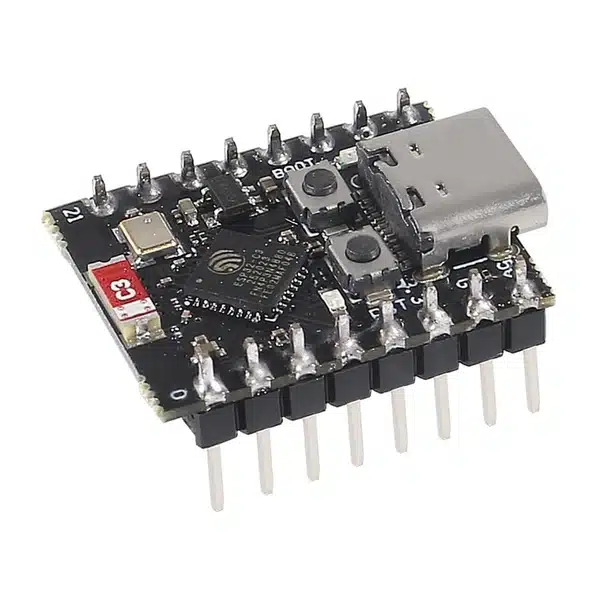
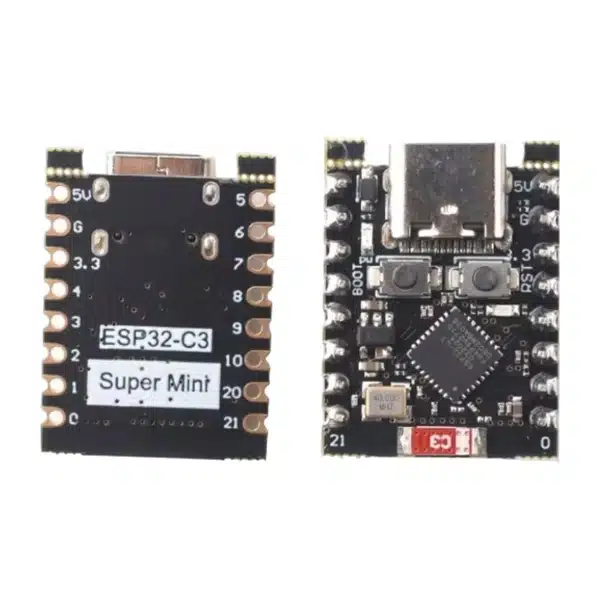
- USB Type-C Interface Provides convenient programming, serial communication and power.
- Pre-Soldered Pin Headers Ready for breadboard prototyping and jumper-wire connections.
- 16 Header Connections Includes 13 accessible GPIO connections and power pins.
- Multiple Communication Interfaces Supports UART, SPI, I2C and PWM.
- Analogue Inputs Suitable for connecting compatible analogue sensors.
- Compact Design Approximately 22.5 x 18mm PCB footprint.
- BOOT and RESET Buttons Convenient programming-mode and board-reset controls.
- Arduino IDE Support Compatible with Arduino ESP32 development tools.
- MicroPython Support Suitable for Python-based embedded programming.
Technical Specifications
Applications
1. Internet of Things (IoT) Projects
The ESP32-C3 SuperMini is ideal for building internet-connected devices that collect sensor readings and transmit information over WiFi.
Examples include temperature monitoring, smart agriculture, environmental monitoring and remote equipment status systems.
2. Smart Home Automation
Build WiFi-controlled switches, sensor-based lighting systems, automatic alarms and smart electronic controllers.
The board can communicate with a local web dashboard or compatible IoT platform.
3. Wireless Sensor Networks
Collect data from temperature, humidity, light, motion and other electronic sensors.
Multiple boards can be used in a distributed sensing system, with communication handled through supported WiFi or BLE applications.
4. Robotics Projects
Use the microcontroller to process sensor information, control motor-driver inputs and communicate wirelessly with other devices.
5. Bluetooth Low Energy Projects
Develop low-power wireless devices that communicate with compatible smartphones and other BLE-enabled equipment.
Bluetooth LE is useful for sensor readings, wireless controls and device configuration.
6. Portable and Compact Electronics
Its small PCB makes the ESP32-C3 SuperMini useful for space-limited electronics, portable instruments and embedded controllers.
7. STEM Education and Programming
Learn microcontroller programming, GPIO control, wireless networking, IoT development and digital electronics using Arduino IDE or MicroPython.
Programming the ESP32-C3 SuperMini Development Board
The board includes a USB Type-C interface for programming and serial communication.
To get started:
- Install the Arduino IDE on your computer.
- Install the Espressif ESP32 board package.
- Connect the SuperMini to your computer using a USB-C data cable.
- Select the appropriate ESP32-C3 board configuration and USB serial port.
- Write or open an example program.
- Upload the program to the board.
- Use the Serial Monitor to observe output messages and debug your project.
If the board does not enter programming mode automatically, the BOOT and RESET buttons can be used to enter the download mode.
DIYGH stocks the USB Type-C Cable 1m (USB-A to USB-C) for compatible programming and power connections.
GPIO and Communication Interfaces
The ESP32-C3 SuperMini exposes programmable GPIO connections for interfacing with electronic components.
These support functions such as:
- Digital input and output
- Analogue-to-digital conversion
- PWM output
- I2C communication
- SPI communication
- UART serial communication
Some GPIO pins have special boot or USB-related functions. Always follow the ESP32-C3 SuperMini pinout when choosing connections.
Using the ESP32-C3 SuperMini with a Breadboard
The pre-soldered headers make this version convenient for circuit prototyping.
It can be connected to a suitable breadboard and interfaced with external sensors, LEDs, displays and control modules.
For circuit construction, DIYGH stocks the Solderless Breadboard MB-102 830-Hole and Male-to-Female Jumper Wires (40pcs).
ESP32-C3 SuperMini vs Standard ESP32 Development Board
The ESP32-C3 SuperMini is particularly useful when compact size, low power consumption and wireless connectivity are priorities.
It features a single-core RISC-V processor and supports WiFi and Bluetooth Low Energy.
The conventional ESP32-WROOM-32 development board offers a dual-core processor, additional accessible GPIO connections and Bluetooth Classic support.
DIYGH also stocks the ESP32 Development Board WiFi + Bluetooth (38-Pin) for projects requiring more connections and additional processing resources.
Important Usage Information
- The ESP32-C3 GPIO pins operate at 3.3V logic levels.
- Do not apply 5V directly to GPIO pins.
- Use a suitable USB-C data cable for programming.
- The board supports 2.4GHz WiFi, not 5GHz WiFi.
- Bluetooth support is BLE, not Bluetooth Classic serial communication.
- Some GPIO pins have boot-configuration functions and require careful selection.
- Use an appropriate driver circuit when controlling motors, relays or other high-current loads.
- Keep the onboard antenna area clear of metal objects where possible.
- Avoid short circuits and incorrect power connections.
Package Includes
- 1 x ESP32-C3 SuperMini Development Board with Pre-Soldered Pin Headers
USB cable, breadboard and external electronic components are not included.
Available from DIYGH Tech Hub, Apatrapa Junction, Kumasi, Ghana , for IoT projects, robotics, smart home automation, electronics education and embedded systems development.