“I know air masses, fronts and cyclones separately. When a question joins them, like the one on the axis of dilation, I don’t know where to begin.”
“My monsoon answer is a row of old theories. I have little on jet streams, ENSO or why the 2026 monsoon fell short.”
“I can write Köppen’s letters from memory. I cannot write its anomalies, or how Thornthwaite tried to overcome them.”
None of this is a lack of effort. Climatology is usually learnt as separate topics, while the questions move between them, and the Indian example is the part most notes leave out. What is missing is one book that takes the atmosphere in sequence and keeps India in view. Climatology is that book.
Why this section is a smart place to spend your hours
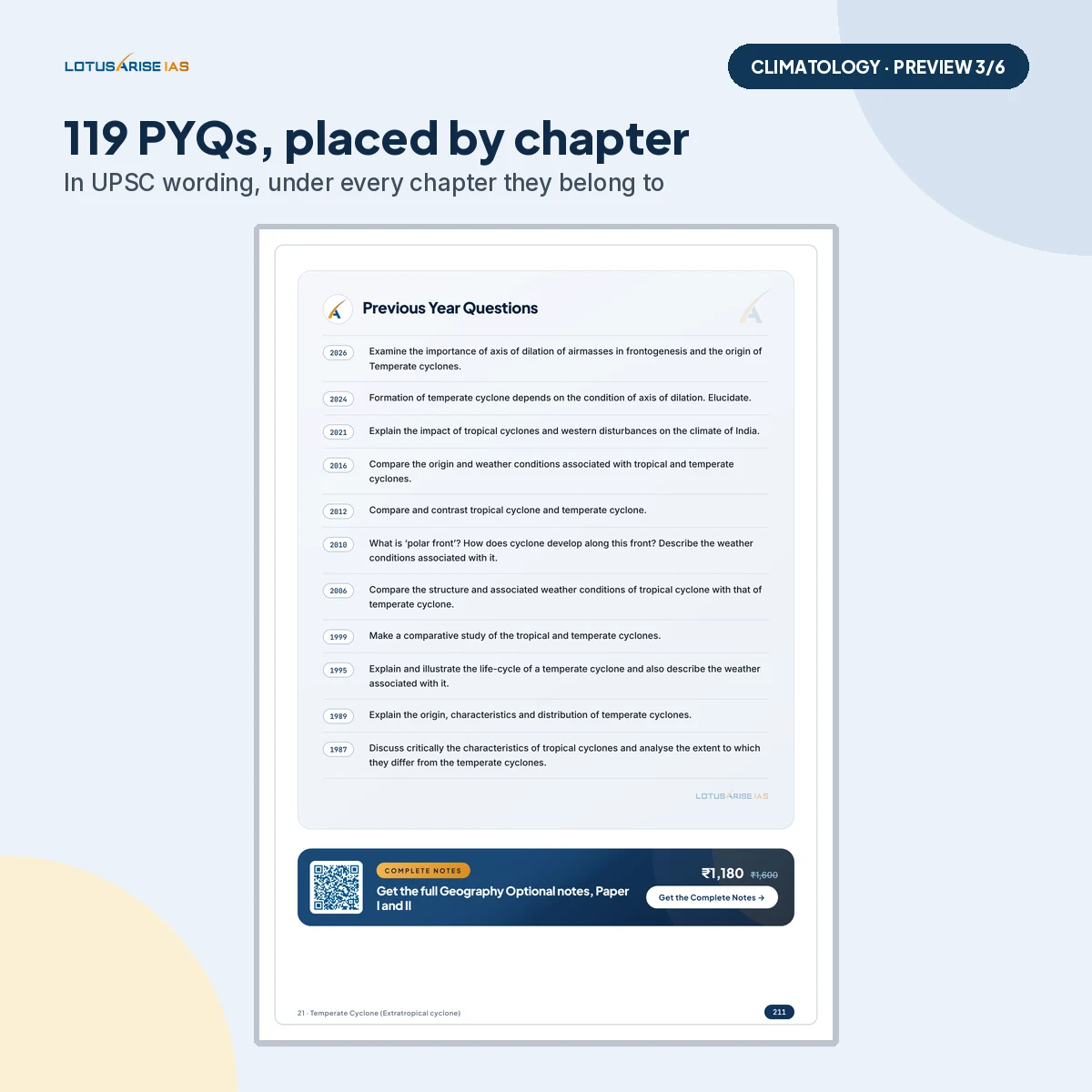
Climatology has a long record in the paper. The book lists 119 PYQs under their chapters (103 distinct questions) from 1986 to 2026, and the contents page shows where they fall: 11 each on temperate cyclones and global warming, 10 each on the monsoon and air masses, 8 each on tropical cyclones and Köppen. Some questions keep coming back. UPSC has asked you to compare tropical and temperate cyclones in 1987, 1999, 2006, 2012 and 2016.
Others are new. The 2026 paper alone asked about the pseudo monsoon, the collapse of the AMOC, the classification of thunderstorms and why winter air stays so poor in the Gangetic plain.
It also pays back across the paper. The mechanism of the Indian monsoon, tropical cyclones, western disturbances and Köppen’s scheme all return in Paper II under India’s climate, and inversions and urban heat islands feed your answers on pollution and cities.
The challenge is not the science. It is having one current account of it that you can actually revise.
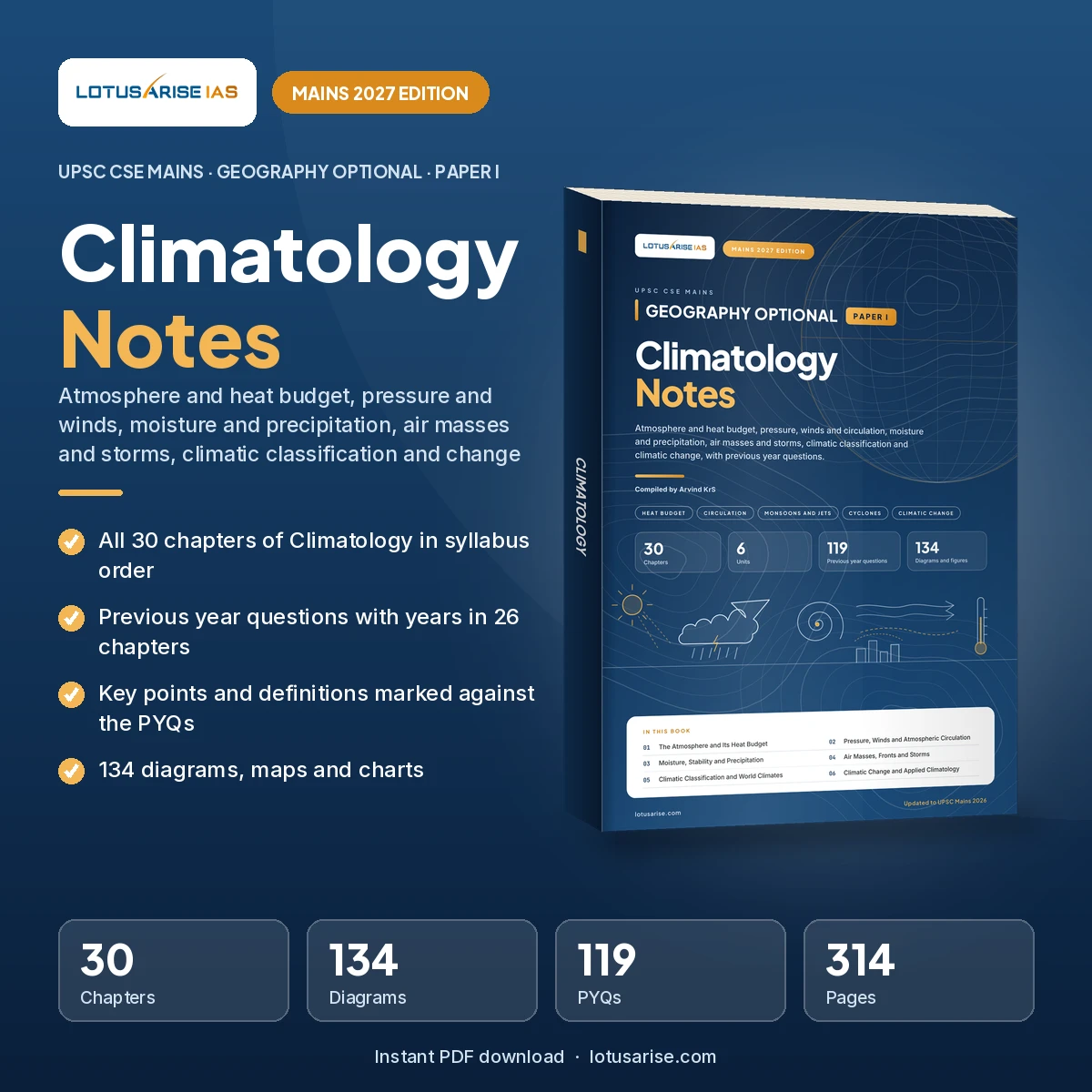
What’s inside — 335 pages in 6 units
☀️ The Atmosphere and Its Heat Budget — 5 chapters
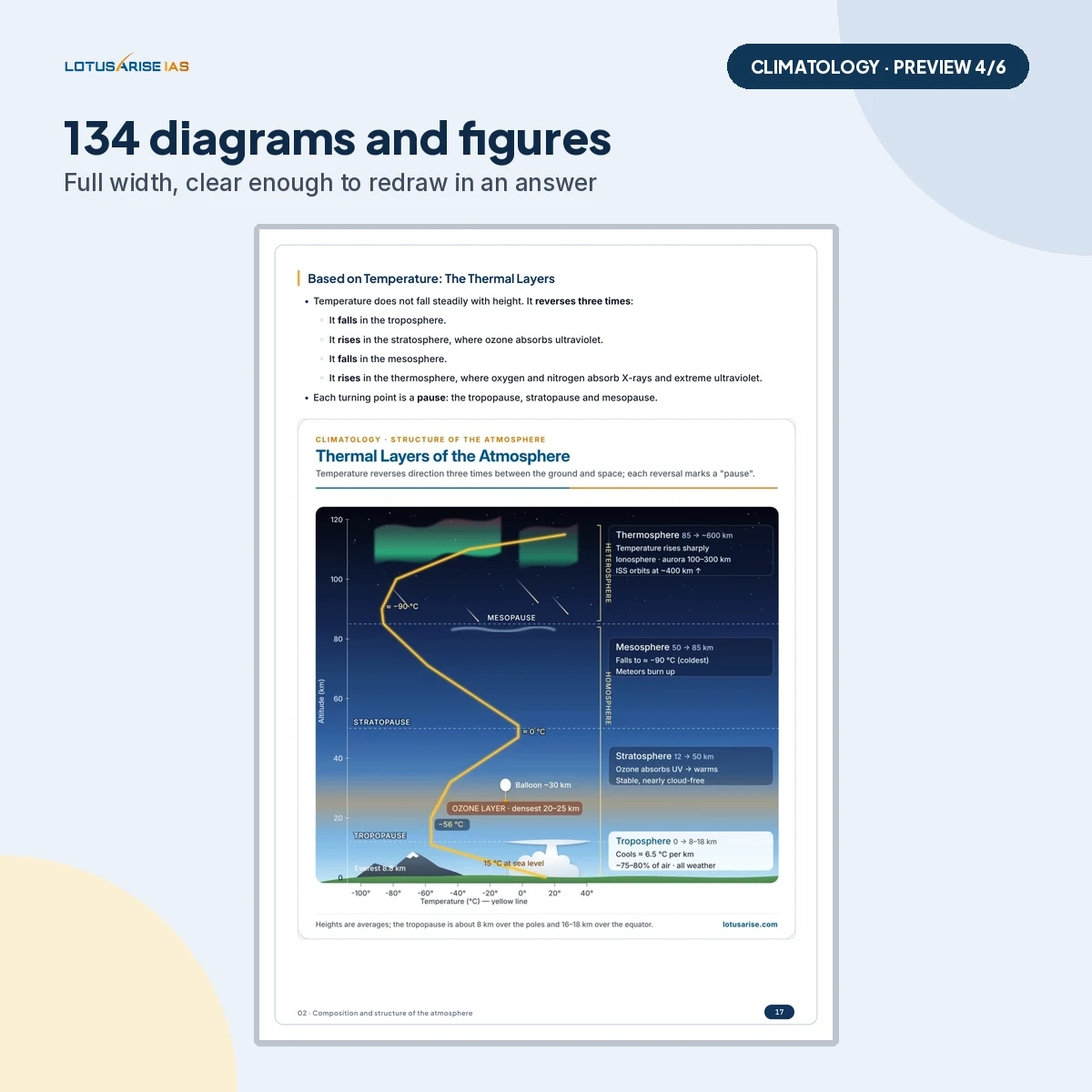
- Origin, composition and structure of the atmosphere
- Insolation, albedo, the heat budget and energy balance
- Temperature belts; temperature inversion and its effects on weather
🌬️ Pressure, Winds and Atmospheric Circulation — 8 chapters
- Pressure belts; pressure gradient, Coriolis force and geostrophic wind
- Planetary, periodic and local winds, with the local winds of India
- Tricellular model, Rossby waves, Walker circulation and the jet stream
- Origin of the monsoon: classical, upper-air and ocean–atmosphere theories
- El Niño, La Niña, ENSO, El Niño Modoki and the MJO
💧 Moisture, Stability and Precipitation — 5 chapters
- Humidity, evaporation, condensation and dew point; stability and lapse rates
- Clouds and cloud seeding; types of rainfall, extreme rainfall and cloudbursts
- The hydrological cycle and global water balance
🌀 Air Masses, Fronts and Storms — 5 chapters
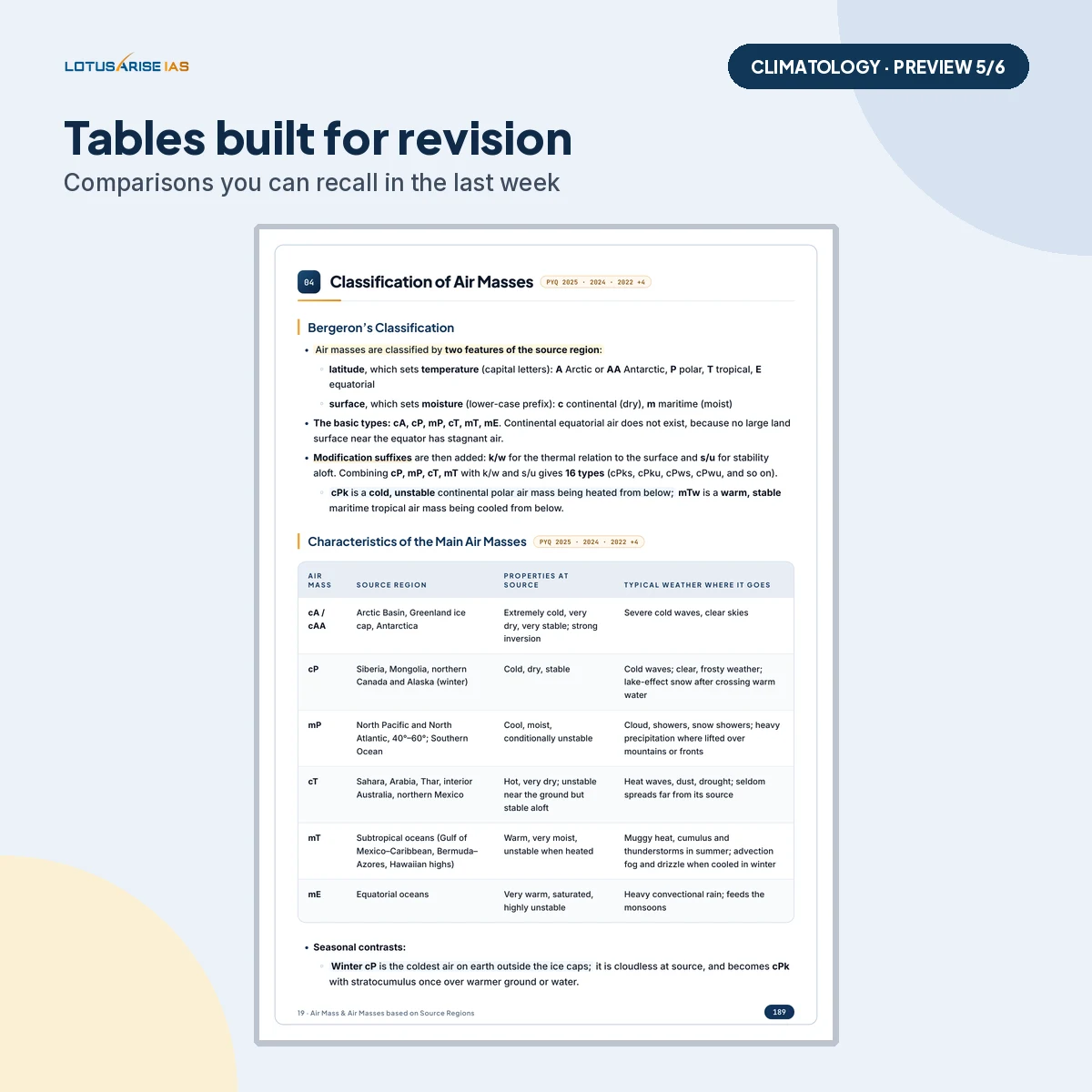
- Air masses, source regions and modification; frontogenesis and frontolysis
- Temperate cyclones and western disturbances; tropical cyclones and India
- Thunderstorms, tornadoes and waterspouts
🗺️ Climatic Classification and World Climates — 4 chapters
- Köppen, Thornthwaite’s 1931 and 1948 schemes and Trewartha, each with India
- Climatic regions of the world: tropical, dry, temperate, cold and highland
🌡️ Climatic Change and Applied Climatology — 3 chapters
- Evidence, past climates, causes and the cryosphere
- Global warming, and the role and response of man
- Urban climate, heat islands, pollution domes and human comfort
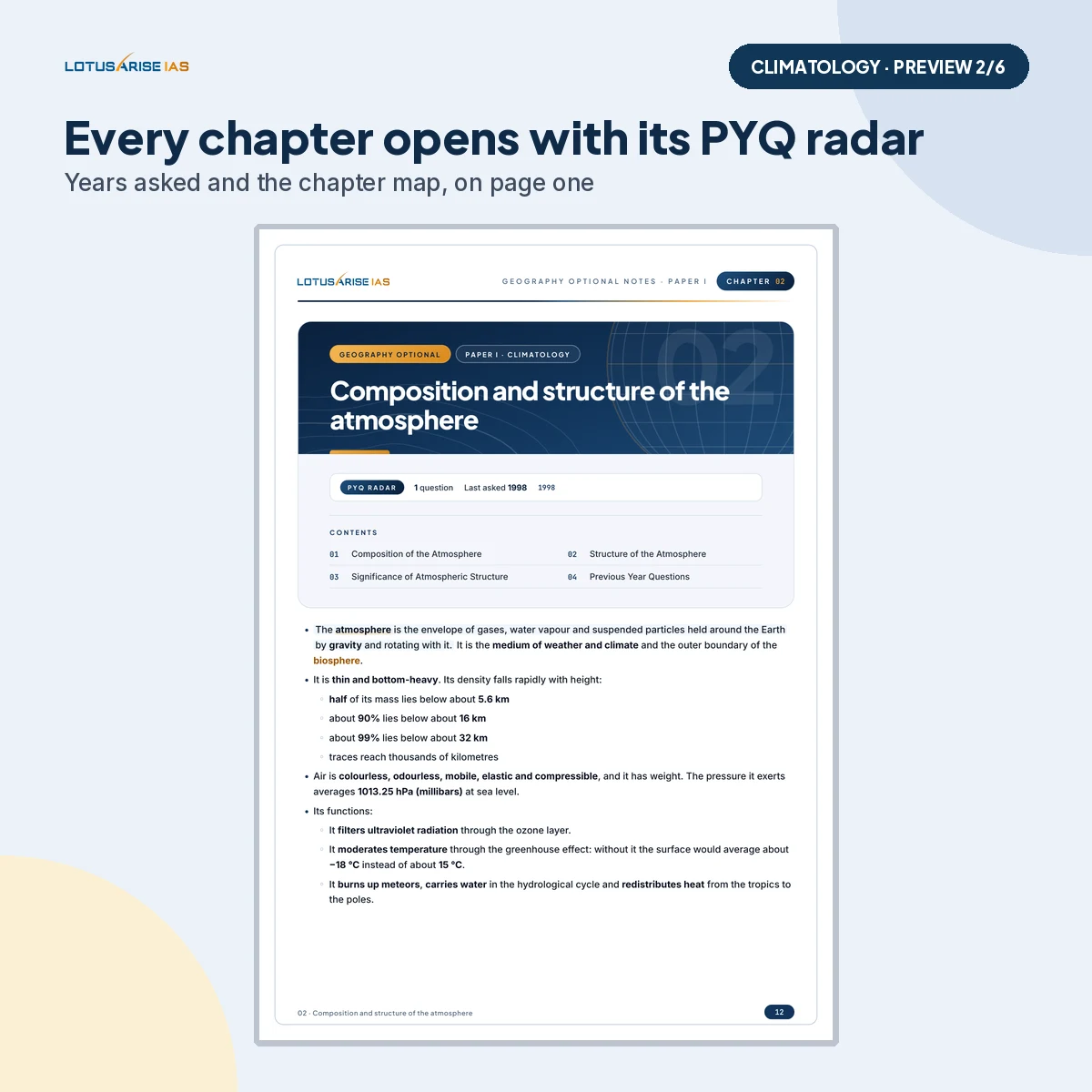
What makes this different from a downloaded PDF? Each chapter is marked against the questions UPSC has actually asked on it. A PYQ radar at the start shows how many times the topic has come and when it last did. Year tags sit on the headings UPSC has asked about. Faint highlights pick out key points, definitions and PYQ terms, so your second reading takes far less time than your first. A question that touches two chapters is listed under both. Five chapters have no direct question yet, and their radars say so.
One thing to be clear about: the book gives the previous year questions, not model answers. Solved answers are in the Geography Optional 300+ Score Pack.
The aspirant who buys this
First-timers You want the atmosphere explained in order from the start. Read from the heat budget to the storms, and the later chapters will lean on the earlier ones.
Repeaters You know the terms, but your answers stay at definitions. Use the evaluation and India sections, then go through the PYQ list at the end of each chapter.
Aspirants short of time before Mains At 335 pages this section can be finished. The radar, year tags and highlights show you what to read first.
Self-study aspirants outside Delhi, Prayagraj and Jaipur No classroom and no batch. You get one organised book that you can read anywhere, and print for sketch practice.
Working professionals One chapter at a time on your phone, offline, with no schedule and no expiry.
State PSC aspirants with Geography The classical climatology is common ground, so the same chapters serve your paper too.
Why not just use free notes from Telegram?
Free notes exist, and most aspirants already have several. Many of these topics are also on our own website, free to read.
The difference is not that free material is wrong. It is that nothing ties it together. A forwarded PDF rarely tells you which of its pages UPSC has asked about, it seldom joins one process to the next, and nobody tells you when it has gone out of date. This book was compiled in October 2026, and its monsoon chapter already covers the 2026 season under a developing El Niño.
If you have the time to build and maintain your own file from scattered sources, you may not need this. If you would rather open one book and start revising, this is what it is for.
The price
335 pages, 30 chapters, 119 PYQs and 134 diagrams and figures — ₹118. That is about 35 paise a page.
This book is also part of Physical Geography: Geography Optional Notes (₹413) and Geography Optional Complete Notes (₹1,180).
One-time payment. No subscription. No recurring charge.
The download link reaches your email right after payment — please check your spam folder if you do not see it. Unlimited downloads, no expiry. English medium.
Read the free sample first (PDF)
For support: support@lotusarise.com