2. Application Scenarios
These bins are ideal for high-volume waste collection in:
- Public Spaces Parks, streets, and community centers.
- Commercial Facilities Shopping malls, office complexes, and hotels.
- Industrial Sites Factories, warehouses, and construction areas.
- Educational Institutions Schools and universities.
3. Model Specifications
Dimensions are listed as Length x Width x Height (L x W x H) in centimeters (cm).
4. Frequently Asked Questions (FAQ)
Q1: What material are these bins made of? A: These commercial-grade bins are typically made from High-Density Polyethylene (HDPE), which is known for its strength, weather resistance, and ability to withstand harsh outdoor conditions and chemical exposure.
Q2: How does the color-coding system work? A: The color-coding is designed to facilitate sorting based on local or national recycling standards. Common uses include:
- Green Organic/Wet waste
- Blue Recyclable materials (paper, plastic, metal)
- Red Hazardous or non-recyclable waste
- Gray General waste
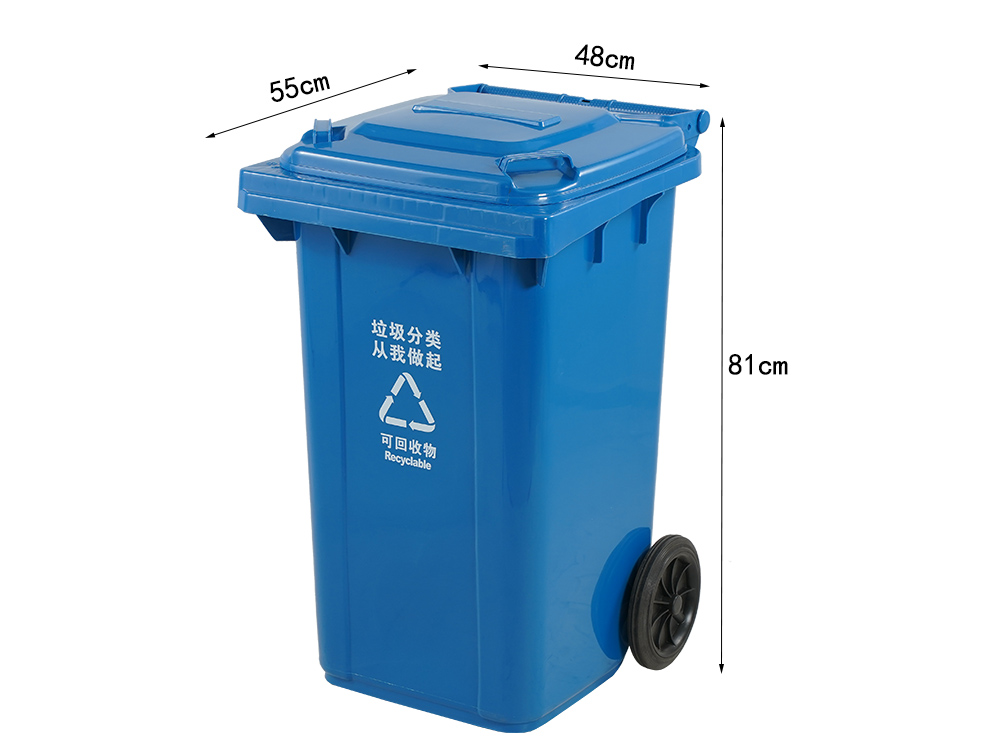
Q3: Are the GX-009 series bins suitable for automatic lifting systems (dump trucks)? A: Yes. The large, wheeled bins (100L, 120L, 240L) are designed with reinforced rims and handles to be compatible with standard municipal and commercial waste collection vehicle lifting mechanisms.
Q4: What is the primary use for the 60L GX-031D model? A: The 60L pedal bin is smaller and more suited for indoor use in high-traffic areas like commercial kitchens, large restrooms, or office break rooms, where hands-free operation is prioritized for hygiene.
Q5: Are the wheels durable? A: Yes, the GX-009 series features robust, solid rubber or plastic wheels designed to handle heavy loads and rough surfaces, ensuring long-term mobility.
More from LSY Plastic
Browse the full Outdoor & Municipal Waste range, or read our guide: Wheelie Bin Buying Guide for Municipalities: EN 840, Sizes and Procurement Tips. Factory-direct MOQ and FOB quotes within 24 hours.
How these bins are moulded
Waste stream first — tell us what goes in the bin and who empties it, and the capacity and lid type usually follow on their own.
Waste bins are moulded in the colour, not painted. The shell is HDPE with UV stabiliser for outdoor duty, and the pedal mechanism — where fitted — is the part that gets cycled tens of thousands of times, so it is specified as a replaceable assembly.
Comparison chart of 120 litre and 240 litre outdoor plastic trash bins with dimensions, capacity and wheel options
Where buyers actually use these bins
Municipalities, facility managers, hotels and restaurants buy bins by waste stream and by lift: who empties them, how often, and with what truck or trolley. Colour and capacity are the first two decisions, not the last.
Y 120l a red 1000 750 33 Y 120l a green 1000 750 33
Ordering, colour coding and shipping
Samples are charged at cost. With bins the sample settles the two things buyers argue about later — the wall gauge and how tightly the lid seats. Domestic orders have no minimum quantity; export orders move as full container loads (FCL).
Outdoor bins are moulded in UV-stabilised HDPE in the finished colour rather than painted, so a scrape does not expose a different shade underneath. Fire-retardant variants are supplied to the rating stated on the product page, and the batch can be certified on request.
Recycling Rubbish Bin — Confirm the liner size and the lid type; those two are the parts buyers get wrong, and both are cheap to fix before tooling and expensive after.
For the full selection logic behind this product family, see our commercial waste bin guide.
FAQ
Are samples free?
Samples are charged at cost, not given away.
Can we mix colours in one container?
Yes, subject to production run planning — confirm the split when you enquire.
Are outdoor bins UV stabilised?
Outdoor models are moulded with UV stabiliser; confirm the duty when ordering.
Matching capacity to the waste stream
This range covers two different jobs that are often bought together and should not be confused. The GX-031D at 60L is a station bin: it sits where waste is generated and is emptied by hand. The GX-009 series at 100L, 120L and 240L are collection containers: they are wheeled to a central point and emptied mechanically, which is why they carry wheels and a pedal rather than a lid you lift by hand.
The sizing logic follows the collection route, not the room. If housekeeping moves waste twice a day, 120L is usually enough for a floor pantry. If waste sits until a nightly run, 240L is the right size — and the 240L unit needs a doorway and a turning space wide enough to actually move it when full, which is the point most often missed at the design stage.
Colour coding: fix the mapping before you order
The range is stocked in red, green, blue and grey. Colour is the entire sorting system, so the mapping has to be decided with the waste contractor, not by the purchasing department. Most schemes use blue for dry recyclables, green for organics or food waste, red for hazardous or clinical waste and grey for general waste — but individual municipalities publish their own variants, and a bin moulded in the wrong colour cannot be corrected afterwards.
If the property operates across more than one municipality, confirm each local scheme separately. A single consistent mapping across the portfolio is worth negotiating for, but it is not always permitted.
Wheels, axles and the part that fails first
On a wheeled container the axle and wheel assembly is the first thing to go. Plain steel axles corrode quickly in coastal or high-humidity locations, and a seized wheel turns a 240L bin into a two-person lift. Specify corrosion-resistant axle hardware for coastal sites, and check that replacement wheels are available as spares — a container that cannot be re-wheeled is scrap long before the body wears out.
What is the difference between 120L and 240L in practice?
Collection frequency and handling space. 120L suits a floor pantry emptied twice daily; 240L suits a central point emptied once a day, but needs enough doorway width and turning space to move when full.
Are the wheels replaceable?
Yes, wheel and axle assemblies are available as spare parts. For a large fleet it is worth holding spares on site.
Can the bins be supplied without wheels?
The GX-031D is the static option at 60L with a foot pedal and no wheels. The GX-009 series is supplied wheeled.
Ordering notes: colour coding and lid fit
The points below are the ones that most often cause a quotation to be revised after the first round. They apply to every model in this range.
- Colour. Send a RAL or Pantone reference rather than a colour name. Stock colours ship faster; a custom shade carries a minimum quantity per colour because the machine has to be purged between runs.
- Export packing. Overseas orders ship as full container loads (FCL). Loose cartons are not consolidated for export. Bins that nest are shipped nested to reduce volume — confirm the nesting arrangement before the deposit, because it changes the container count.
- Samples. Samples are supplied at cost price plus freight, not free of charge.
- Lead time. Stock colours from existing moulds run a few weeks from deposit and artwork confirmation. Custom colour or new tooling adds time; the schedule is confirmed in writing with the quotation.
- Documentation. Commercial invoice, packing list and bill of lading are standard. A certificate of origin is issued where the destination needs it for duty purposes.
Related reading: waste bins for UAE and GCC markets, waste bin colour codes by market, trash can size guide.
Where these bins ship
Bin containers from this line go mostly to Vietnam, UAE and GCC, Qatar, Nigeria and Ghana. Export orders move full container load; samples are charged at cost and credited against a confirmed order.